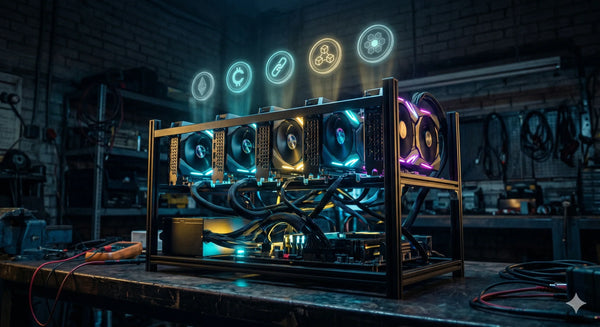
Every crypto bull market follows the same script for mining hardware. Coin prices surge, profitability calculators flash green, social media fills with screenshots of daily earnings, and suddenly everyone wants a miner. Vendors raise prices. Lead times stretch. Miners that sat unsold for months are now backordered. And thousands of newcomers pay peak prices for hardware that won't pay itself back before the cycle turns.
This article isn't about discouraging you from mining — we sell mining hardware, and we genuinely believe in home mining in Australia. But we'd rather you buy smart and profit long-term than buy emotionally and regret it. Here's how the bull market trap works, how to recognise it, and when you should actually pull the trigger on hardware.
How the Bull Market Trap Works
The trap has four stages, and they repeat with remarkable consistency every cycle.
Stage 1: Prices Rise, Profitability Spikes
When Bitcoin or altcoin prices climb, mining revenue measured in fiat increases immediately. A miner earning $5/day suddenly earns $12/day. Profitability calculators — which snapshot current difficulty and current price — show absurd ROI timelines. "This Antminer S21 Pro pays itself off in four months!" It looks like free money.
Stage 2: Hardware Demand Explodes
Retail and institutional buyers flood the market. Manufacturers like Bitmain, MicroBT, and Canaan increase production, but supply can't match demand overnight. Reseller prices climb 30–100% above MSRP. Miners that cost $2,000 six months ago now sell for $3,500. Even older-generation units like the Antminer S19K Pro or WhatsMiner M30S that were borderline unprofitable months earlier get snapped up at inflated prices.
Stage 3: Difficulty Catches Up
This is the part the profitability calculators don't show you in their default view. As thousands of new machines come online globally, mining difficulty adjusts upward. For Bitcoin, this happens roughly every two weeks. Your share of the block rewards shrinks proportionally. That $12/day drops to $8, then $6, even if the coin price stays flat.
Stage 4: Price Corrects, You're Underwater
Bull markets don't last forever. When the price corrects — and it always does — you're left with hardware you overpaid for, earning less than projected, with difficulty still elevated from all the machines that came online during the mania. Your ROI timeline that was "four months" is now eighteen months or never. Meanwhile, the same hardware is available on the secondhand market for half what you paid.
The Numbers Don't Lie: A Worked Example
Let's make this concrete with a hypothetical Australian scenario.
Imagine buying an ASIC miner during a bull market peak for $4,500 AUD. At the time of purchase, BTC is trading at $160,000 AUD and the calculator says you'll earn $18/day at your electricity rate of $0.31/kWh. After power costs of $7/day, that's $11/day net — ROI in roughly 13.5 months. Looks reasonable.
Now factor reality. Over the next six months, difficulty rises 35% as all those bull-market machines come online. Your daily revenue drops to $11.70 before electricity. Net profit: $4.70/day. Then BTC corrects 30% to $112,000 AUD. Revenue drops further to $8.19/day, netting just $1.19/day after power. Your ROI timeline has blown out to over 10 years — on hardware with a typical lifespan of 3–5 years.
Had you waited three months for the hype to cool, you might have bought the same miner for $2,800 AUD, at which point even the lower post-correction earnings produce a viable 2–3 year payback. Timing matters enormously.
Five Warning Signs You're Buying at the Top
Here's how to tell if you're walking into the trap:
1. Hardware Is Selling Above MSRP Everywhere
When every reseller has a markup and "limited stock" warnings are plastered across every listing, that's a demand-driven price spike. Manufacturer-suggested prices exist for a reason. If you're paying 40% over MSRP, you need the coin price to stay elevated just to break even — and that's a bet, not a plan.
2. Your ROI Calculation Assumes Current Difficulty
The single biggest mistake new miners make is treating today's difficulty as a constant. It isn't. If you're not modelling at least a 3–5% monthly difficulty increase in your projections, your ROI estimate is fiction. Our guides on mining difficulty and payout variance explain why this matters so much.
3. Mainstream Media Is Covering Mining Profitability
When news.com.au or the ABC are running stories about how profitable crypto mining is, you're late. The people who made money already bought their hardware during the quiet periods. By the time mainstream coverage arrives, hardware prices have already inflated and the best margins have already been captured.
4. Old-Gen Hardware Is Selling for New-Gen Prices
This is perhaps the clearest signal. When someone is asking $2,500 for a Canaan Avalon A1246 that should sell for half that based on its efficiency, the market has lost the plot. The resale value dynamics of mining hardware follow predictable patterns — when those patterns break to the upside, it's mania, not value.
5. You're Feeling FOMO, Not Doing Maths
Be honest with yourself. If your purchase decision is driven by "everyone else is making money" rather than a spreadsheet with conservative assumptions, walk away. The maths either works or it doesn't. Emotion is not a mining strategy.
When SHOULD You Buy Mining Hardware?
The best time to buy is almost always when it feels like the worst time. Here are the conditions that historically produce the best ROI for hardware purchases:
During Bear Markets and Accumulation Phases
When crypto prices are flat or declining, hardware demand drops. Manufacturers discount. Resellers sit on inventory. This is when you get MSRP or below-MSRP pricing on current-gen hardware. Yes, the profitability calculators will look grim at purchase time — but you're buying the hardware at its cheapest, and when the next cycle comes, your fully depreciated machine is printing money while others are paying peak prices.
When New-Gen Hardware Launches
New-generation miners make the previous generation obsolete on efficiency. When Bitmain launches a new S-series or MicroBT releases a new WhatsMiner, the outgoing models drop in price rapidly. Our upgrade timing guide and brand comparison can help you spot these windows. The outgoing model might still be perfectly profitable at the discounted price — you just need to assess it carefully.
When You Have a Genuine Cost Advantage
If you have access to cheap or free electricity — solar panels, off-peak TOU tariffs, or a location in a low-rate state like Queensland — the maths works at price points that don't work for others. A genuine structural cost advantage changes the equation regardless of cycle timing. But even then, you still shouldn't overpay for the hardware itself.
The Secondhand Market Trap Is Real Too
Bull markets don't just inflate new hardware prices. The secondhand market goes haywire too. Miners with unknown hash board history, expired warranties, and questionable remaining lifespan suddenly command prices close to new units. If you're going to buy used, at least do it during a quiet market when sellers are motivated and you can negotiate properly.
What to Do Instead of Panic-Buying Hardware
If you're in the middle of a bull run and feeling the urge to buy miners, here are more productive uses of your time and money:
- Research and plan. Use the bull market to learn. Read up on SHA-256, Scrypt, and other algorithms. Compare ASICs vs GPUs. Understand miner statistics. When prices correct and hardware becomes affordable, you'll be ready to move fast and buy with confidence.
- Prepare your infrastructure. Sort out your electrical setup, mining location, network cabling, and cooling strategy. Infrastructure costs don't fluctuate with crypto cycles — do this work now so you're plug-and-play when the right hardware deal appears.
- Optimise what you already have. If you're already mining, focus on efficiency. Tune your overclock settings, explore custom firmware like BraiinsOS+ or LuxOS, and review your pool choice for better payout terms. Squeezing 5% more efficiency from existing hardware is free alpha.
- Sort out your tax position. Bull markets mean larger AUD-denominated mining income, which means bigger ATO obligations. Make sure your record-keeping is tight and your depreciation claims are optimised. Every dollar saved on tax is a dollar you can put toward hardware when the price is right.
The Contrarian Mindset Wins
The miners who consistently do well in this industry are contrarians. They buy hardware when forums are full of "mining is dead" posts. They accumulate coins when profitability calculators show red. They sell or upgrade hardware when demand peaks and they can get top dollar for their used units on the resale market.
This isn't unique to crypto mining — it's basic investing logic applied to physical infrastructure. Buy low, earn through cycles, upgrade strategically. The bull market trap catches people who do the opposite: buy high on emotion, earn diminishing returns as difficulty adjusts, and sell at a loss when the cycle turns.
The Bottom Line
If you're reading this during a bull market and feeling the urge to buy your first miner at whatever price you can find — pause. Run the numbers with a 5% monthly difficulty increase. Check whether the hardware is priced at or above MSRP. Ask yourself whether you'd buy this machine at this price if the coin was worth 40% less tomorrow.
If the answer is still yes, go for it. If the answer is "only if the price keeps going up" — that's not a mining investment, that's a leveraged bet on price. And there are cheaper ways to make that bet than buying physical hardware.
When you are ready to buy — whether that's now or after the cycle cools — MinerHub stocks Bitcoin miners, altcoin ASICs, GPUs, and rig accessories at transparent pricing with Australia-wide shipping. No inflated hype pricing, no pre-order games. Browse the full ASIC range or get in touch if you want help choosing the right hardware for your situation and budget.