If you've spent any time researching Bitcoin miners, you've seen the term SHA-256 plastered across every spec sheet. It's listed under "algorithm" for every machine in our Bitcoin miner range — from compact home units to industrial-grade rigs. But what actually is SHA-256, and why does it matter for mining?
This guide breaks it down clearly, no computer science degree required.
What Is SHA-256?
SHA-256 stands for Secure Hash Algorithm 256-bit. It's a cryptographic hash function developed by the United States National Security Agency (NSA) and published in 2001 as part of the SHA-2 family of algorithms.
In plain terms, SHA-256 is a mathematical formula that takes any input — a word, a sentence, an entire document, or a block of transaction data — and converts it into a fixed-length 64-character string of letters and numbers called a hash. That hash is always exactly 256 bits (32 bytes) long, regardless of how large or small the input was.
Here's a simple example:
Input:  "MinerHub"
Output: 3b6a27bcceb6a42d62a3a8d02a6f0d73653215771de243a63ac048a18b59da29
Change even a single character in the input — lowercase the "m" — and the output hash changes completely. This is called the avalanche effect, and it's one of SHA-256's most important properties.
The Key Properties of SHA-256
SHA-256 has four properties that make it suitable for securing a financial network like Bitcoin:
- Deterministic — The same input always produces the same hash output. Every node on the Bitcoin network can verify results independently.
- One-way (Pre-image Resistant) — You cannot reverse a hash to find the original input. Given a hash output, there is no mathematical shortcut to reconstruct what went in.
- Collision Resistant — It is computationally infeasible to find two different inputs that produce the same hash output. This prevents double-spend attacks and transaction manipulation.
- Avalanche Effect — A tiny change to the input produces a completely different output. This makes it impossible to "nudge" a hash toward a target value — you have to start from scratch each time.
These properties are why SHA-256 was chosen as the foundation for Bitcoin's proof-of-work consensus mechanism.
How SHA-256 Works Inside Bitcoin Mining
Bitcoin's network needs a way to reach consensus — to agree on which new block of transactions is valid and should be added to the blockchain — without relying on a central authority. The solution is proof-of-work: to add a block, a miner must prove they've done real computational work. SHA-256 is the work.
Here's the process, step by step:
Step 1 — Transactions are gathered into a block
Pending Bitcoin transactions are bundled together into a candidate block. This block includes transaction data, a timestamp, and a reference to the previous block in the chain (making it a "chain" of blocks).
Step 2 — A nonce is added
The block header includes a variable called a nonce — a number the miner can freely change. The miner's job is to find a nonce value that, when SHA-256 is applied to the block header, produces a hash that meets the network's current difficulty target.
Step 3 — The hash must start with enough leading zeros
The Bitcoin network sets a difficulty target: a valid block hash must begin with a certain number of zeros. The more zeros required, the harder it is to find a valid hash — there are fewer hashes that qualify, so miners have to try more combinations.
An example of what a valid Bitcoin block hash looks like:
0000000000000000000a3b2c4d1e5f6789abcdef...Step 4 — Miners iterate trillions of times per second
Finding a nonce that produces a hash meeting the target is pure trial and error. There's no shortcut. A miner takes the block data, appends a nonce, runs SHA-256 (Bitcoin actually runs SHA-256 twice — double SHA-256), checks the result, and if it doesn't meet the target, increments the nonce and tries again.
Modern ASIC miners do this trillions of times per second. That's what hashrate measures — how many SHA-256 calculations per second the hardware can perform.
Step 5 — A valid hash is found and broadcast
When a miner finds a nonce that produces a valid hash, they broadcast the completed block to the network. Other nodes verify the proof-of-work (a single SHA-256 calculation to check) and add the block to the chain. The winning miner receives the block reward plus transaction fees.
Why ASIC Miners Exist
General-purpose hardware — CPUs, then GPUs — can run SHA-256, but they're not optimised for it. An ASIC (Application-Specific Integrated Circuit) is a chip engineered at the hardware level to do nothing but SHA-256 calculations, as fast and as efficiently as possible.
This is why efficiency is measured in joules per terahash (J/TH) on modern miners. A lower J/TH figure means the miner performs more SHA-256 calculations per watt of electricity consumed — which directly determines whether mining is profitable at your electricity rate.
For a closer look at how efficiency affects profitability at Australian electricity rates, see our guide: Home Mining in Australia: What Electricity Rate Makes It Profitable?
SHA-256 Miners Available in Australia
Every Bitcoin miner in our range runs SHA-256. Here are some current options across different tiers:
Entry-Level / Home Mining
Canaan Avalon Nano 3S — 6 TH/s, 140W, Wi-Fi enabled. A quiet desktop unit that runs SHA-256 at a rate suited to home solo mining or educational setups.
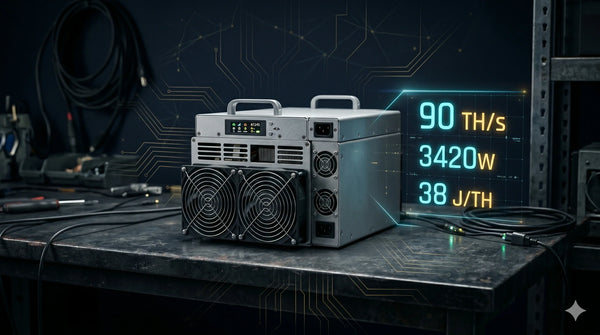
Canaan Avalon Q — 90 TH/s, 18.6 J/TH, Wi-Fi. A compact tower-form SHA-256 miner aimed at home users who want serious hashrate without a full rack setup.
Mid-Range
Canaan Avalon A1246 — 90 TH/s, integrated PSU, 4-fan air cooling. A proven workhorse from Canaan's commercial lineup.
Canaan Avalon A1346 — 110 TH/s, 3300W, 6-fan cooling. Higher hashrate with competitive efficiency for its generation.
MicroBT WhatsMiner M30S — 94 TH/s, 3400W. A well-regarded SHA-256 machine from MicroBT, built for continuous operation.
MicroBT WhatsMiner M31S+ — 84 TH/s, 3360W. A solid mid-tier SHA-256 machine with a proven uptime record.
High-Performance
Bitmain Antminer S19K Pro — 120 TH/s, 2760W. One of the most recognised SHA-256 ASICs in the world, used extensively in commercial facilities.
Bitmain Antminer S21 — 151 TH/s, 2643W. Bitmain's current-generation SHA-256 flagship, offering a step-change in efficiency over previous S19 hardware.
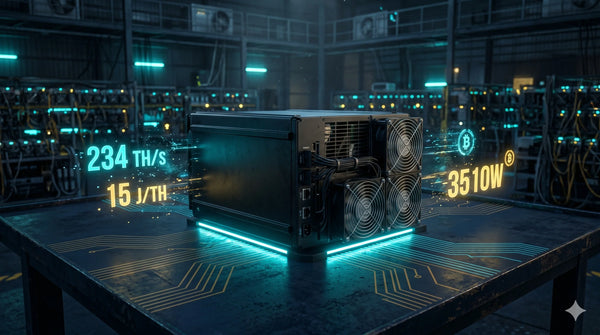
Bitmain Antminer S21 Pro — 234 TH/s, 3510W. The highest-hashrate SHA-256 ASIC in our range, built around Bitmain's 5nm BM1370 chip at 15 J/TH.
Browse the full range in our Bitcoin Miners collection.
Solo SHA-256 Mining: The Lottery Approach
Not every SHA-256 miner is connected to a pool. A small but enthusiastic segment of the mining community runs solo SHA-256 hardware — low-hashrate open-source devices where the goal isn't consistent earnings but the chance of solo-finding a full Bitcoin block.
The NerdQX 8 TH/s open-source solo miner and the Gamma 602 1.2–1.8 TH/s solo miner are built for this use case — running SHA-256 independently and broadcasting directly to the Bitcoin network, without a mining pool intermediary.
For a full breakdown of the pool vs solo decision, read: Mining Pool vs Solo Mining: Which Is Best for Beginners?
SHA-256 vs Other Mining Algorithms
Bitcoin's use of SHA-256 doesn't mean all ASIC miners use it. Different cryptocurrencies use different proof-of-work algorithms, and each requires different hardware:
- Scrypt (Litecoin & Dogecoin) — Miners like the Fluminer L1 and Goldshell Mini Doge III are purpose-built for Scrypt. A SHA-256 ASIC cannot mine Scrypt coins.
- KHeavyHash (Kaspa) — The IceRiver KS0 Ultra runs KHeavyHash, not SHA-256.
- ETCHash / EtHash (Ethereum Classic) — The iPollo V2X and Jasminer X4-Q are ETC-specific ASICs.
This algorithm specificity is the defining characteristic of ASIC hardware — and it's why choosing the right miner for your target coin matters so much. For a full comparison of hardware categories, see: ASIC Mining vs GPU Mining in 2026: Which Is Right for You?
Mining Difficulty and SHA-256: Why Hashrate Alone Isn't Everything
Bitcoin's network automatically adjusts its difficulty target every 2,016 blocks (approximately every two weeks) to keep the average block time close to 10 minutes. As more SHA-256 hashrate joins the network, the target becomes harder — more leading zeros are required — making each individual unit of hashrate statistically less likely to find the next block.
This is why raw TH/s figures only tell part of the story. Efficiency (J/TH), current network difficulty, BTC price, and your electricity rate all feed into whether a SHA-256 miner is profitable at a given moment.
For a deeper look at this dynamic, read: Understanding Bitcoin Mining Difficulty: Why Hashrate Isn't Everything
For profitability modelling specific to Australian electricity prices, see: Electricity Prices in Australia and the Real Cost of Crypto Mining in 2026
Can SHA-256 Be Broken?
Not with any known or foreseeable technology.
To "break" SHA-256 in a mining context would mean finding a mathematical shortcut that lets you predict what nonce will produce a valid hash without actually computing it — effectively reversing or pre-computing the hash function. No such shortcut exists. The security of SHA-256 rests on the same mathematical foundations that secure global banking, government communications, and SSL certificates across the internet.
Theoretical quantum computing attacks (particularly Grover's algorithm) could reduce SHA-256's effective security from 256 bits to approximately 128 bits — still astronomically secure by any practical standard. The Bitcoin development community monitors this space, and the protocol has the capacity to upgrade its proof-of-work algorithm if SHA-256 were ever genuinely threatened.
For everyday mining purposes: SHA-256 is secure, stable, and going nowhere.
Getting Started with SHA-256 Mining
If you're new to Bitcoin mining and want a practical starting point, our step-by-step setup guide walks through everything from choosing your first miner to connecting to a pool: How to Set Up Your First Bitcoin Miner in Australia
To explore the full range of SHA-256 Bitcoin miners available for Australian delivery, visit our Bitcoin Miners collection or browse all ASIC hardware in our ASIC Miners collection.
Questions about which SHA-256 miner suits your setup? Get in touch — we're based in Australia and happy to help.