Home Bitcoin mining in Australia has always been a numbers game — and in 2026, those numbers are more interesting than they've been in years. Bitcoin is trading at significant levels in Australian dollar terms, a new generation of sub-20 J/TH ASICs has arrived, and a growing segment of Australians are running miners from their garage, spare room, or home office.
But Australia also has some of the highest residential electricity rates in the world. That single fact shapes everything about home mining viability here — more than hashrate, more than hardware price, more than BTC price.
This guide breaks down the real picture: what home mining looks like in 2026, what the numbers actually say, and which setups give Australian home miners the best chance of coming out ahead.
The Australian Electricity Problem
In 2026, Australian residential customers are paying between 30 and 35 cents per kilowatt-hour on average, depending on their state and retailer — with South Australia consistently at the top and Victoria and Tasmania among the lower end. That's not the cheapest electricity in the world for mining.
To put it in mining terms: a miner consuming 3,000W running 24 hours a day uses 72 kWh per day. At 32c/kWh, that's $23.04 per day in electricity alone — $691 per month, $8,395 per year.
This is why efficiency (measured in joules per terahash, or J/TH) is the single most important spec for Australian miners. A miner that produces the same hashrate while using less power changes the profitability calculation entirely. For a detailed breakdown of how your specific electricity rate maps to mining margins, read our guide: Home Mining in Australia: What Electricity Rate Makes It Profitable?
What's Changed in 2026
Despite expensive electricity, 2026 is a more viable environment for Australian home miners than it was two or three years ago for a few reasons:
More efficient hardware is now accessible
The current generation of Bitcoin ASICs — including Bitmain's S21 series — operates at around 15–17.5 J/TH, a significant improvement over older S19-era hardware that ran at 23–30 J/TH. That means more hashes for the same electricity spend. For home miners, newer hardware narrows the gap between Australian electricity costs and profitability.
BTC/AUD is elevated
With Bitcoin trading in the range of AUD $95,000–$110,000 through mid-2026, the revenue side of the mining equation is meaningful even at modest hashrates. Each satoshi earned is worth more in AUD than it was a few years ago, which directly improves payback periods on hardware.
Compact, quiet home-specific hardware now exists
The era of home-friendly ASICs is genuinely here. Several manufacturers now produce miners designed specifically for residential use — Wi-Fi enabled, low-noise, standard power outlets — that don't require a data centre rack or industrial three-phase power. More on those below.
Home Mining vs Pool Mining: The Setup That Makes Sense
Almost all home Bitcoin miners in Australia connect to a mining pool rather than mining solo. Here's why that matters:
Solo mining means your hardware competes directly against the entire Bitcoin network — currently running at multiple exahashes per second — for the right to find the next block and claim the full 3.125 BTC reward (post-2024 halving). With a single home miner at 90–150 TH/s, the probability of finding a block solo is astronomically low. You might wait years — or never find one at all.
Pool mining combines your hashrate with thousands of other miners. The pool finds blocks regularly and distributes rewards proportionally to each miner's contributed hashrate. The earnings are smaller per event but consistent and predictable — far better suited to a home setup where you're paying ongoing electricity costs.
For the full breakdown of this decision, read: Mining Pool vs Solo Mining: Which Is Best for Beginners?
That said, there is a growing community of Australians running ultra-low-hashrate solo miners — small open-source devices like the Gamma 602 or NerdQX — purely for the lottery-ticket thrill of potentially finding a full block. These draw minimal power and are more hobby than income strategy. More on those in the compact miner section below.
The Hardware: Which ASICs Make Sense for Australian Home Miners
Not every ASIC is suited to home use. Industrial miners designed for data centres — loud, power-hungry, requiring hardwired ethernet and often three-phase power — are difficult to run in a residential setting. The miners below are selected specifically for home viability in the Australian context.
Best for low power bills and quiet operation
Canaan Avalon Nano 3S — 6 TH/s, 140W
The Nano 3S is purpose-built for home use. It draws just 140W — less than two standard light globes — connects via Wi-Fi, and runs quietly enough to sit on a desk. At 6 TH/s it won't generate significant pool income, but it's the ideal entry point for learning the mechanics of Bitcoin mining, or as a permanently running low-cost lottery miner on solo pool. Payback is long at Australian electricity rates, but power costs are minimal.
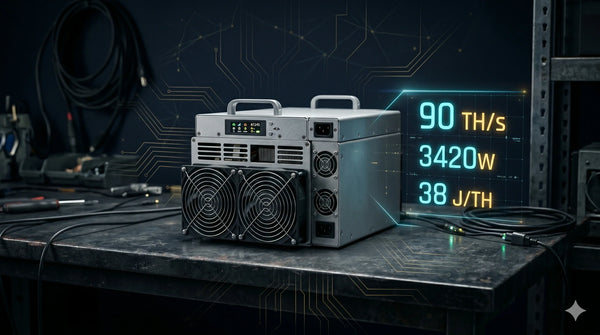
Canaan Avalon Q — 90 TH/s, 18.6 J/TH, Wi-Fi
The Avalon Q is the standout home-friendly mid-range miner in 2026. It delivers 90 TH/s at 18.6 J/TH — meaning roughly 1,674W at full load — in a compact tower form factor with Wi-Fi connectivity. No hardwired ethernet required, no rack needed, and noise levels are manageable in a garage or utility room. This is the machine to benchmark your electricity rate against first.
Best mid-range performers
Canaan Avalon A1246 — 90 TH/s, integrated PSU
A proven SHA-256 workhorse from Canaan's commercial lineup. The A1246 has an integrated PSU and 4-fan air cooling — less elegant than the Avalon Q for home use, but a reliable performer with a track record of uptime.
Canaan Avalon A1346 — 110 TH/s, 3300W
A step up in hashrate with 6-fan cooling. Power draw is significant — dedicated circuit territory — but hashrate and efficiency are competitive for its generation.
MicroBT WhatsMiner M30S — 94 TH/s, 3400W
MicroBT's commercial-grade machine at a lower entry price point. Solid and dependable, though power draw at 3400W means you'll want a dedicated 15A circuit at minimum.
MicroBT WhatsMiner M31S+ — 84 TH/s, 3360W
Similar power draw to the M30S with slightly lower hashrate, but a well-regarded machine with good reliability.
High-performance options
Bitmain Antminer S19K Pro — 120 TH/s, 2760W
The S19K Pro is more power-efficient than the WhatsMiner M30S/M31S while delivering more hashrate — 23 J/TH is S19-era efficiency, but the 2760W draw is more manageable than older 3400W+ machines. One of the most widely deployed Bitcoin ASICs globally.
Bitmain Antminer S21 — 151 TH/s, 2643W
The S21 is the efficiency sweet spot for 2026 home mining in Australia. At 17.5 J/TH and 151 TH/s with a 2643W draw, it's both high-performing and meaningfully more efficient than the S19 generation. If you have the electrical capacity, this is the machine that makes the profitability maths work most favourably at Australian electricity rates.
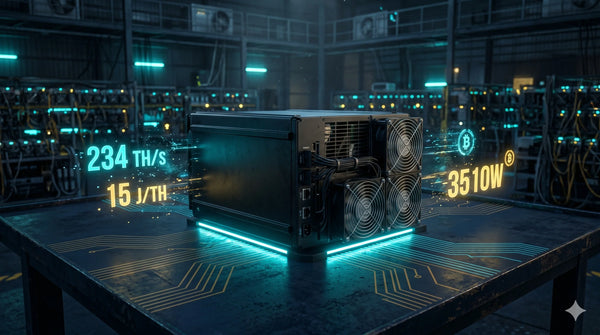
Bitmain Antminer S21 Pro — 234 TH/s, 3510W
The most powerful SHA-256 ASIC in our range, built around Bitmain's 5nm BM1370 chip at 15 J/TH. The best efficiency ratio available — but the 3510W draw is firmly in the "dedicated circuit and good ventilation" category. This is a machine for a serious home setup with proper electrical infrastructure.
Browse the complete range in our Bitcoin Miners collection.
Solo lottery miners
If you want to run a Bitcoin miner without significant electricity cost — accepting that consistent income is not the point — the open-source solo miners are worth knowing about:
Gamma 602 — 1.2–1.8 TH/s, BM1370 chip
A compact, open-source solo Bitcoin miner drawing very low power. Connect it to a solo pool like CKPool and you're buying a lottery ticket that runs 24/7 at minimal electricity cost.
NerdQX — 8 TH/s, 4× BM1370, 180W
More hashrate than the Gamma for a still-modest power draw. The NerdQX runs open-source firmware and is popular with the hobbyist mining community as a silent, always-on solo mining device.
Running the Numbers: Australian Home Mining in 2026
Let's model a realistic scenario. We'll use the Antminer S21 as a reference point — 151 TH/s, 2643W — at a typical Australian electricity rate of 32c/kWh, with Bitcoin at AUD $100,000.
- Daily electricity cost: 2.643 kW × 24 hours × $0.32 = $20.30/day
- Annual electricity cost: ~$7,410/year
- Daily mining revenue depends on current network difficulty, BTC price, and pool fees — use a live calculator like WhatToMine or CryptoCompare with current network difficulty for precise figures, as these change every two weeks with Bitcoin's difficulty adjustment
The key variable you control is your electricity rate. If you can get below 25c/kWh — through an off-peak tariff, a solar and battery system, or a better retail plan — the profitability picture shifts substantially. This is why electricity rate optimisation is the highest-leverage action an Australian home miner can take.
For a full state-by-state breakdown of electricity costs and their mining implications, read: Electricity Prices in Australia and the Real Cost of Crypto Mining in 2026
Mining Difficulty: The Factor Most Home Miners Underestimate
Bitcoin's network difficulty adjusts every 2,016 blocks — approximately every two weeks — to keep the average block time at 10 minutes. As more hashrate joins the network globally, the difficulty rises, and your share of rewards shrinks proportionally, even if your hardware hasn't changed.
This means profitability calculations from six months ago may no longer reflect current reality. The hardware you buy today will be mining against a network that may be significantly harder in 12 months.
Understanding how this affects long-term returns is essential before purchasing: Understanding Bitcoin Mining Difficulty: Why Hashrate Isn't Everything
Mining vs Just Buying Bitcoin
It's a fair question — and one worth asking honestly. If Bitcoin appreciation is the goal, buying BTC directly avoids electricity costs, hardware depreciation, setup complexity, and noise. Mining introduces all of those in exchange for generating BTC through operational cost rather than capital outlay.
Mining makes the most sense when you: have access to below-average electricity rates, want the consistent drip of BTC accumulation through pool rewards, enjoy the hardware and operational side of it, or want exposure to Bitcoin that isn't simply a market buy.
For an honest comparison of both approaches, read: Mining vs Buying Crypto: Which Is Better in 2026?
Practical Setup Considerations for Australian Home Miners
Electrical requirements
Any miner drawing above 1,500W should ideally be on a dedicated circuit. Machines in the 2,600–3,500W range require a 15A or 20A dedicated circuit — standard in Australian homes but worth confirming with a licensed electrician before you run two or three large ASICs simultaneously. Running multiple high-draw miners on a shared circuit is a safety risk and will trip your breaker repeatedly.
Ventilation and heat
ASICs generate significant heat. In an Australian summer, running a 3kW miner in an enclosed space will raise ambient temperatures quickly, which reduces efficiency and shortens component life. A ventilated garage, utility room, or outdoor-rated enclosure is the right environment. Factor cooling into your setup planning from day one.
Noise
Industrial ASICs are loud — 70–80 dB is common. For home use, either choose purpose-built quiet hardware (Avalon Q, Avalon Nano 3S) or plan for physical separation from living areas. A sealed garage with the door closed reduces noise transmission significantly.
Internet connectivity
Mining pool connectivity requires a stable internet connection. Wi-Fi-enabled miners (Avalon Nano 3S, Avalon Q) are flexible to place, but ethernet-connected machines on a wired connection are more reliable. Brief internet outages cause the miner to pause but cause no permanent damage — it will reconnect and resume automatically.
Firmware
Keeping your miner's firmware updated ensures you're benefiting from manufacturer performance improvements and security patches. Some miners support third-party firmware that unlocks underclocking modes — useful for reducing power draw at the cost of some hashrate, which can improve efficiency at high electricity rates. Read more: What Is Mining Firmware and Should You Flash Yours? | 2026 Guide
Getting Started
If you're new to Bitcoin mining and ready to set up your first machine, our step-by-step guide walks through everything from choosing hardware to configuring your pool connection: How to Set Up Your First Bitcoin Miner in Australia (Step-by-Step)
To compare hardware side by side and find the right machine for your electricity rate and available space, browse our full Bitcoin Miners collection or the wider ASIC Miners range.
Not sure which machine is right for your setup? Get in touch with the team — we're Australian-based and happy to talk through the numbers with you.