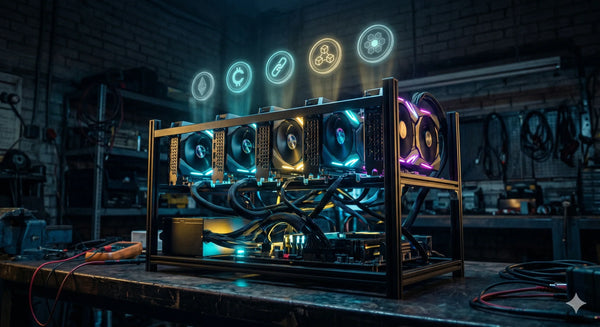
A shed or detached garage is a genuinely attractive place to run a Bitcoin miner. The noise stays away from your living space, there's usually more room for airflow and cooling, and you're not dealing with heat buildup inside your home. Plenty of Australian home miners make exactly this choice.
But a shed or garage isn't a blank canvas that sits outside the rules. Before you run an extension cord out the back and fire up a miner, there are some practical questions worth getting answers to: Does your property zoning allow it? Do you need a permit for the electrical work? What about noise if you're running a commercial-grade ASIC? And what does the ATO expect from you?
This guide walks through each of these areas honestly. None of it is legal advice — for your specific situation, you'll want to speak with your local council and a licensed electrician — but it gives you a clear picture of what to look into before you start.
Is Your Property Zoned for This?
Most Australian residential properties are zoned under a category that permits residential use and limited home-based business activity. Running a small number of ASIC miners in a shed or garage generally sits within what councils classify as a "home business" or "home-based business" — defined broadly as a commercial activity carried out on a residential property by residents of the dwelling, that doesn't materially affect the amenity of the neighbourhood.
The key conditions most councils place on home-based businesses in residential zones are:
- No employees visiting the property (other than residents)
- No customers or clients attending the site
- No signage visible from the street
- No unreasonable noise, vibration, odour, or waste
- The activity must not generate traffic beyond what's normal for a residence
A mining setup in a shed ticks most of these boxes easily — no clients, no signage, no traffic. The sticking point for larger commercial ASIC setups is noise. More on that shortly.
If you're in a rural zone, the rules are often more permissive. Larger structures and higher-wattage operations face fewer restrictions on rural lots than in standard residential zones. If you're in a strata property, apartment complex, or have a shared-title arrangement, you'll need to check by-laws — some explicitly prohibit commercial activities in any outbuilding, and body corporate approval may be required.
What to do: Look up your property's zoning on your state or local council's planning portal. In most states, the planning portal will tell you your zone classification and what uses are permitted, permitted with conditions, or prohibited. If you're unsure, a quick call or email to your council's planning department is usually sufficient to get a clear answer for a simple home business inquiry.
Does Your Shed or Garage Need a Building Permit?
If you're running miners in an existing shed or garage, a building permit for the structure itself is likely already resolved — it either had one when built, or was built before permit requirements applied. The question becomes more relevant if you're planning to build a new shed, modify an existing one, or add infrastructure like a dedicated subpanel, ventilation ducting, or air conditioning.
As a general guide, most Australian states require a building permit for sheds that include electrical installations. Adding a powered subpanel to an existing shed — which is the right approach for running multiple ASICs — will typically require a licensed electrician and may trigger a building permit or at minimum an electrical compliance certificate depending on your state. The rule of thumb across most states is: any shed with electrical, plumbing, or drainage connections requires formal approval.
State-by-state, the general thresholds before a building permit is required for the structure itself look roughly like this:
- NSW: Sheds under 20m² in residential zones can be exempt development, but electrical installations require a licensed electrician and compliance certificate regardless of size.
- VIC: Sheds under 10m² and under 3m in height may not require a permit for the structure, but any electrical work requires a licensed electrician and Certificate of Electrical Safety.
- QLD: Sheds under 10m² may be exempt; anything with electrical connections requires licensed work and compliance certification.
- WA: Sheds under 10m² may not require a building permit, but electrical installations always require a licensed electrician and inspection.
- SA: Most sheds require Development Approval; any electrical work requires a licensed electrician.
- TAS: A building permit is required for most shed modifications; electrical work requires licensed contractors.
These are general guides only — your local council or a licensed building certifier in your state will give you the definitive answer for your specific property and proposed works.
The Electrical Side: This Is the Most Important Practical Step
This is where most home miners need to spend the most time and money — and where cutting corners creates real risk.
Running a single low-power miner like the Canaan Avalon Nano 3S (140W) off a standard power point is fine. Running a commercial ASIC like the Antminer S21 (2,643W) or the Antminer S21 Pro (3,510W) — or several of them — off a standard domestic circuit is not. Continuous high-load draw on an undersized circuit is a fire risk and will trip breakers constantly.
What a proper shed mining setup requires:
A dedicated subpanel
A sub-distribution board fed from your main switchboard, sized for the total load you intend to run plus a reasonable safety margin. This needs to be designed and installed by a licensed electrician. In Australia, all electrical work above DIY lamp replacement must be performed by a licensed tradesperson — this applies in every state and territory, without exception.
Correct circuit sizing
Each commercial ASIC miner should ideally run on its own dedicated circuit, correctly rated for the miner's power draw. Some miners also require specific outlet types (C13/C19 IEC connectors rather than standard Australian 3-pin outlets) — your electrician needs to know the spec of each machine before wiring.
Earthing and surge protection
Mining equipment is expensive and sensitive to power quality. A surge protection device (SPD) on your subpanel is a worthwhile investment. Your electrician can advise on the appropriate specification.
Supply capacity at the meter
If you're planning to run multiple commercial ASICs, your existing supply from the grid may need upgrading. A single-phase 63A service — standard for most suburban homes — can support around 14–15kW of continuous load at 240V. Multiple large ASICs can approach or exceed this. Your electrician can arrange a supply upgrade through your network operator (e.g. Western Power in WA, Ausgrid in NSW) if required. This involves the network operator, not just your internal wiring, and can take time to arrange.
Compliance certificate
Once the electrical work is complete, your licensed electrician must provide a Certificate of Electrical Safety (or equivalent in your state). This is your documentation that the work was done correctly and inspected. Keep it — it's important for insurance purposes.
Noise: The Most Common Neighbour Issue
This is the area where home miners running commercial ASIC hardware in a shed have the most exposure to neighbour complaints and council enforcement.
Commercial Bitcoin ASICs are loud. The Antminer S21 Pro runs at around 75 dB — comparable to a vacuum cleaner running continuously. Multiple units compound that noise. A standard timber-framed garden shed provides very little acoustic attenuation. Neighbours in close proximity will hear it.
Australian residential noise rules are administered at the state and local council level. Most jurisdictions don't set a specific dB limit for home-based business noise but instead use a "reasonable person" test — the noise must not unreasonably affect the amenity of neighbouring properties. Environmental Protection Authorities in each state have enforcement powers, and councils can issue noise abatement orders that require you to cease or modify operations.
Practical mitigation options:
- Acoustic treatment inside the shed — Mass-loaded vinyl, rockwool insulation panels, and acoustic foam on internal walls meaningfully reduce noise transmission. A lined, sealed shed is substantially quieter externally than an unlined metal shed.
- Positioning — Orient exhaust fans away from neighbouring properties and boundary fences. The direction of noise propagation matters.
- Operating hours — If complaints are a concern, configuring miners to throttle or shut down during late-night hours is possible with some firmware configurations. This isn't ideal for profitability but may be necessary in tight residential situations.
- Consider low-power alternatives — If your shed is close to neighbours, the Canaan Avalon Nano 3S, NerdQX, or Gamma 602 are near-silent alternatives that remove the noise issue entirely, at the cost of hashrate.
For a broader look at managing ASIC heat and noise in Australian conditions, see our guide: Thermal Management for ASIC Miners: Cooling Your Setup in the Australian Summer
Insurance: Does Your Home Policy Cover This?
Standard home and contents insurance policies in Australia almost universally exclude business activities from coverage. If mining hardware in your shed is damaged by a power surge, fire, or theft — and your insurer determines the equipment was being used for a commercial purpose — your claim may be denied.
There are two things worth checking:
- Your existing home policy: Contact your insurer and disclose that you are operating mining equipment in an outbuilding. Some insurers will extend coverage with an endorsement; others will exclude it. The critical thing is to disclose — if you don't and you claim, you may find the claim void.
- A business or business contents policy: A small business insurance policy covering contents and electronic equipment is the cleaner solution for a mining setup of any meaningful scale. Premiums are manageable for a home-scale operation.
ATO Obligations: What the Tax Office Expects
Running miners in a shed doesn't change your tax obligations — it just makes them more visible. The ATO treats crypto mining income as ordinary assessable income in the year it's received, valued at the AUD market price on the date of each receipt. This applies whether you're pool mining with daily micro-payouts or solo mining with occasional block rewards.
If your mining operation reaches the scale of a business rather than a hobby — which the ATO assesses based on factors including regularity, scale, commercial intent, and profit expectation — you may also have obligations around GST registration (if annual turnover exceeds $75,000), ABN registration, and deductions for electricity, depreciation, and other operating costs.
Running even a modest multi-ASIC setup in a shed is likely to push you into business territory under the ATO's guidelines. Setting up record-keeping from day one — electricity costs, hardware purchase prices, mining income, and dates of receipt — is strongly recommended. An accountant familiar with crypto taxation is worth engaging before you scale up.
For a comprehensive overview of ATO obligations for Australian miners, see: ATO Crypto Mining Tax Guide 2026: What Australian Miners Need to Declare
Practical Setup Checklist for Shed or Garage Mining
Before you start, work through these steps in order:
- Check your zoning — Confirm your property's zone classification and that home-based business activity is permitted. Contact your local council if unclear.
- Assess your existing structure — Does the shed have adequate ventilation for the heat output of your planned equipment? Is it structurally sound and weatherproof?
- Engage a licensed electrician — Get a quote for a dedicated subpanel, correctly rated circuits, appropriate outlets, and a surge protection device. Don't skip this step.
- Check your grid supply capacity — If running multiple commercial ASICs, confirm your existing supply is adequate or arrange an upgrade through your network operator.
- Assess noise and neighbour proximity — If running loud commercial hardware, plan acoustic treatment before you start, not after a complaint arrives.
- Notify your insurer — Disclose the mining activity and confirm your coverage position before the equipment is running.
- Set up record-keeping — Spreadsheet, accounting software, or a crypto tax tool. Start tracking from the first day of operation.
Which Miners Are Best Suited to a Shed Setup?
The answer depends on your shed, your electrical capacity, and your neighbours. Browse the full Bitcoin Miners collection for the current range, or consider these options based on your situation:
- Low-power, near-silent home setup: Gamma 602 (~15W) or NerdQX 8 TH/s (~20W) — run off a standard power point, zero noise concerns, minimal electrical work required.
- Mid-power with Wi-Fi convenience: Canaan Avalon Nano 3S (140W) — commercial build quality, near-silent, suits a shed with standard power.
- Commercial hardware in a properly set up shed: Antminer S21 (2,643W) or Antminer S21 Pro (3,510W) — requires dedicated circuits, acoustic treatment, and adequate supply capacity. High hashrate, high noise, high electricity draw.
For guidance on whether commercial mining makes sense at Australian electricity rates, see: Home Mining in Australia: What Electricity Rate Makes It Profitable?
Questions about setting up a shed mining operation? Get in touch with us — we're based in Perth and can talk through hardware selection and setup for your specific situation.
Note: This article is general information only and does not constitute legal, financial, or electrical advice. Regulations vary by state and local council. Always consult your local council, a licensed electrician, and a qualified accountant for advice specific to your property and circumstances.