The used GPU market in 2026 is flooded with post-gaming-boom hardware, and two cards come up constantly in Australian mining conversations: the NVIDIA GeForce RTX 3080 and the AMD Radeon RX 6700 XT. Both are available second-hand at prices that would have seemed impossible two years ago. But they are very different machines with very different economics. This guide breaks down what actually matters — hashrate, power draw, efficiency, purchase price, and algorithm flexibility — so you can make a decision grounded in numbers rather than brand loyalty.
The Basics: What You're Actually Buying
The RTX 3080 is a Ampere-generation card from late 2020. The standard 10GB model uses GDDR6X memory on a 320-bit bus and draws around 320–340W at stock settings. It was one of the fastest gaming GPUs of its generation and also became a popular mining card during the Ethereum era due to its high Ethash hashrate. NVIDIA has since moved on to Ada Lovelace, which means 3080s are now widely available second-hand.
The RX 6700 XT is AMD's RDNA 2 card from early 2021. It uses 12GB of GDDR6 on a 192-bit bus, but crucially benefits from AMD's 96MB Infinity Cache — a large on-chip cache that compensates for the narrower memory bus in gaming workloads. It draws around 200–215W at stock and has proven to be a highly efficient miner after power limit tuning. You'll find these second-hand too, often at noticeably lower prices than the 3080.
If you want to understand how GPU mining compares to dedicated ASIC hardware before committing to either card, read our ASIC mining vs GPU mining 2026 guide first. And if you're just getting started, our GPU mining rig parts list explains everything you need beyond the card itself.
Algorithm Compatibility: What Can They Actually Mine?
Both cards are broadly compatible with GPU-mineable algorithms, but their strengths differ depending on the memory architecture.
The RTX 3080's GDDR6X memory gives it very high memory bandwidth — around 760 GB/s — which translates to excellent performance on bandwidth-heavy algorithms. Its strength historically was Ethash (Ethereum, ETC), where raw memory bandwidth dominated. On ETCHash (Ethereum Classic), the 3080 10GB delivers around 95–100 MH/s at stock, dropping to around 85–90 MH/s after power-limit reduction to the 200–220W range.
The RX 6700 XT is a strong ETCHash miner too, pushing around 47–50 MH/s at stock. After reducing power limit to 55–65% (115–140W), it sustains 44–47 MH/s — making it significantly more efficient per watt than the 3080 on the same algorithm. On Autolykos v2 (Ergo), the 6700 XT delivers around 90–100 MH/s — an area where AMD's Infinity Cache architecture particularly shines. On KawPow (Ravencoin) the 6700 XT delivers around 28–32 MH/s.
Both cards support algorithm switching freely. If ETC profitability shifts, you can move to Ergo, Ravencoin, Flux, or Kaspa (via GPU miners) within minutes — a flexibility that no ASIC offers. If you want to understand how algorithm-specific ASIC miners approach these coins, our best altcoin ASIC miners guide covers the dedicated hardware landscape.
Power Draw and Efficiency: The Number That Matters in Australia
Australian residential electricity is expensive. Most states sit between $0.28 and $0.38 per kWh, with WA on Synergy's standard tariff at around $0.33 per kWh. For GPU mining to make sense, your hardware needs to earn more per day than it costs to run. That means efficiency — measured as MH/s per watt — is the metric you should be optimising, not raw hashrate.
Here's how the two cards compare on ETCHash after tuning:
| Card | Tuned Hashrate (ETCHash) | Tuned Power Draw | Efficiency (MH/W) |
|---|---|---|---|
| RTX 3080 10GB | ~88 MH/s | ~210W | ~0.42 MH/W |
| RX 6700 XT 12GB | ~46 MH/s | ~125W | ~0.37 MH/W |
The 3080 has higher absolute hashrate, but the efficiency gap is narrower than most people expect. At Australian electricity rates, power cost per MH matters a lot. Running a tuned 3080 at 210W for 24 hours costs roughly $1.65/day at $0.33/kWh. The 6700 XT at 125W costs around $0.99/day. That's a $0.66/day difference in electricity cost per card — significant when you're running six GPUs in a rig.
Our guide to electricity prices in Australia and crypto mining breaks down the real cost of running hardware across different state tariffs in detail. And if you're in WA, QLD, or NSW, our state electricity rate comparison gives you current residential tariffs to plug into your own calculations.
VRAM: Why 12GB vs 10GB Might Matter
One practical consideration often overlooked: the RX 6700 XT has 12GB of VRAM versus the RTX 3080's 10GB. For most current GPU mining algorithms this doesn't matter — DAG sizes for ETC are well under 4GB. But VRAM headroom matters in two ways.
First, if you're dual-mining (running two algorithms simultaneously, which some mining software supports), more VRAM gives you more flexibility. Second, if you ever repurpose these GPUs for AI inference workloads — running local LLMs, Stable Diffusion, or similar — the 12GB of the 6700 XT handles larger models without offloading to system RAM. The 3080 10GB can be limiting here, particularly as model sizes have grown. The GDDR6X vs GDDR6 distinction doesn't help or hurt mining meaningfully; it's primarily a gaming-bandwidth consideration.
Second-Hand Purchase Considerations in Australia
In mid-2026, both cards are easy to find on Facebook Marketplace, Gumtree, and eBay Australia. Price points vary significantly by condition and region, but as a rough guide the RX 6700 XT typically trades at a significant discount to the RTX 3080 despite being competitive on efficiency. That discount affects your return on investment timeline directly.
When buying used GPUs for mining, things to check include: thermal paste condition (mining cards often have degraded compound from sustained high-temperature operation), VRAM temperature under load (the 3080's GDDR6X is known to run hot), fan bearing health, and any BIOS modifications made by a previous owner. Cards that were mined on at reduced power limits for their whole life often have less wear than gaming cards that were pushed hard at stock.
Before buying used, it's worth reading our full guide on new vs second-hand mining hardware — while written for ASICs, the principles of wear assessment, seller vetting, and pricing fundamentals apply equally to GPUs.
Rig Context: How Many Cards, What Infrastructure?
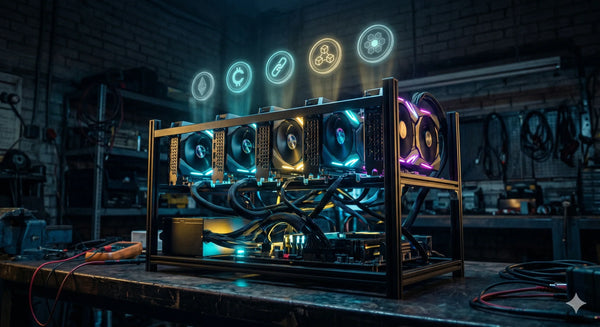
A single GPU mining decision can't be made in isolation — it depends on your rig setup. A 6-GPU rig of RTX 3080s at 210W each draws 1,260W continuously from the wall (accounting for PSU inefficiency, closer to 1,400W at the meter). A 6-GPU rig of RX 6700 XTs at 125W draws 750W continuously — roughly 830W at the meter. The difference in your electricity bill over a month is meaningful.
If you're planning a multi-card build, you'll need the right motherboard and chassis. The ASRock H510 PRO BTC+ supports up to 6 GPUs and is a proven mining board with PCIe slot spacing designed for riser cables. For the chassis itself, our open-frame ATX mining chassis provides the airflow clearance that sustained GPU mining requires — closed gaming cases trap heat and reduce component lifespan. For power, our 2000W modular ATX mining PSU handles a 6-card 3080 rig with headroom to spare, and operates at full rated wattage on Australian 230V supply.
Our full GPU rig build guide walks you through each component decision in detail if you're starting from scratch.
Algorithm Flexibility vs Dedicated ASIC: An Honest Comparison
The core value proposition of GPU mining in 2026 is flexibility. An ASIC miner like the iPollo V2X will outperform either GPU on ETCHash per dollar — it delivers 1,200 MH/s at 165W, which is efficiency in another league. Similarly, the IceRiver KS0 Ultra dominates Kaspa mining with 400 GH/s at 100W. If you know exactly what algorithm and coin you want to mine and you're confident in that coin's future, a purpose-built ASIC beats both GPUs on efficiency and hashrate per dollar.
Where GPUs win is pivotability. If ETCHash dries up tomorrow, your RX 6700 XT or RTX 3080 moves to a different algorithm the same day. An ETC ASIC cannot. That optionality has real value in a volatile altcoin market. Read our altcoin mining vs Bitcoin mining guide for a broader view of where the GPU mining opportunity sits in 2026.
The Verdict: Which Card Should Australian Miners Buy?
If purchase price is the primary constraint: the RX 6700 XT is typically cheaper second-hand than the RTX 3080, draws significantly less power, and its lower running costs at Australian electricity rates mean the efficiency gap in your favour compounds every month. For a home miner on a 30c+ tariff, six 6700 XTs will almost always outperform six 3080s on a return-on-investment basis once electricity is factored in.
If absolute hashrate matters more than efficiency — for example, you're on a cheap off-peak tariff, or have solar offsetting daytime consumption — the RTX 3080's higher MH/s per card becomes relevant. You can fit more hashing power into a 6-slot rig with 3080s than 6700 XTs, which matters if motherboard slots and physical rig space are the binding constraint rather than electricity.
For most Australian home miners paying standard residential tariffs, the RX 6700 XT's lower power draw makes it the more defensible purchase. You can find the Sapphire NITRO+ RX 6700 XT and the ASUS TUF RTX 3080 in our mining GPU collection, alongside the rest of our current GPU lineup. Browse the full GPU miners collection for rig-ready options.
If you're still weighing up whether GPU mining is the right approach versus a dedicated altcoin ASIC, our altcoin ASIC miners collection shows what dedicated hardware looks like at comparable price points. Either way, run your own numbers with your actual electricity rate before committing — that single variable determines more of the outcome than the card choice itself.