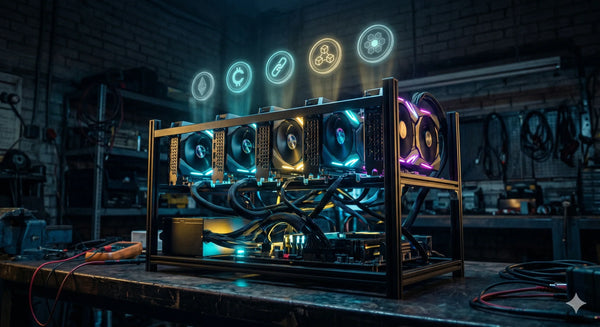
If you've spent any time in crypto mining communities, you've seen the photos — ASIC hashboards fully submerged in tanks of clear fluid, running cool and completely silent. Immersion cooling looks like the future of mining. But most of those setups are running dozens of machines in purpose-built facilities. The question for Australian home miners is different: does immersion cooling make sense for a single ASIC in your garage or shed?
The short answer is that it can work, and the results are genuinely impressive — but the cost, complexity, and ongoing maintenance mean it's a project for tinkerers and enthusiasts, not a straightforward upgrade. Here's everything you need to know before you commit.
What Is Immersion Cooling and How Does It Work?
Immersion cooling replaces air as the heat transfer medium with a dielectric (non-conductive) liquid. You remove the fans from your ASIC, strip it down to the bare hashboards and control board, and submerge the components in a tank filled with engineered coolant. Heat transfers from the chips into the fluid, which is then either passively convected or actively pumped through an external radiator or heat exchanger to dissipate the thermal energy.
The physics are straightforward: liquid is roughly 1,000 times more efficient at absorbing heat than air. That means chip temperatures drop dramatically — often 15–25°C lower than air-cooled operation — and the entire system runs in near-total silence because there are no fans. For context, if you've ever dealt with the noise challenges covered in our thermal management guide for Australian summers, you'll immediately see the appeal.
There are two main approaches:
- Single-phase immersion: The coolant stays liquid at all times. Heat is removed by pumping the warm fluid through a radiator. This is the most practical option for home setups.
- Two-phase immersion: The coolant boils at a low temperature, and the vapour condenses on a cold surface above the tank, dripping back down. More efficient, but the fluids are significantly more expensive and the tank design is more complex. Not realistic for a single home ASIC.
The Real Costs of a Single-ASIC Immersion Setup
This is where most people's enthusiasm hits reality. A home immersion setup for a single miner like an Antminer S21 or Avalon A1346 requires several components, and none of them are cheap.
The tank: You need a container large enough to fully submerge the hashboards with room for fluid circulation. Purpose-built immersion tanks run $500–$1,500 AUD for a single-miner size. DIY options using modified steel or aluminium containers are possible but need to be fully sealed, corrosion-resistant, and structurally sound — the filled tank will weigh 40–80 kg depending on volume.
Dielectric coolant: This is the biggest single expense. Engineered dielectric fluids like BitCool, Engineered Fluids ElectroCool, or ThermaSafe cost roughly $15–$30 AUD per litre, and a single-ASIC tank typically needs 40–60 litres. That's $600–$1,800 just for the fluid. Mineral oil is a cheaper alternative at $5–$10 per litre, but it's messier, harder to clean off components, and degrades faster. Synthetic fluids last longer and have better thermal properties, but the upfront cost is steep.
Pump and radiator: You need a submersible or inline pump rated for continuous 24/7 operation (typically 10–20W) and an external radiator — either a car-style heater core or a purpose-built liquid cooling radiator with fans. Budget $150–$400 AUD for a reliable pump-and-radiator loop.
Miscellaneous: Fittings, hoses, temperature sensors, a dry-break connector if you want clean maintenance access, and potentially a reservoir or overflow system. Another $100–$300.
All up, a functional single-ASIC immersion setup runs $1,350–$4,000 AUD depending on whether you go DIY or buy purpose-built components, and whether you use mineral oil or engineered dielectric fluid. That's a significant investment on top of the miner itself — for reference, that cost range overlaps with the price of many of the ASIC miners in our store.
What You Actually Gain
So what does that money buy you? The benefits are real, and for the right person, they're compelling.
Near-silent operation: With no fans, the only noise is the pump — which is typically a low hum comparable to a fish tank filter. If noise is your primary barrier to mining at home, immersion eliminates it entirely. Compare this to the inline fan and ducting setups that reduce noise but don't eliminate it.
Lower chip temperatures: Immersion-cooled ASICs typically run with chip temperatures in the 45–60°C range, compared to 70–85°C under air cooling. Lower temperatures reduce electromigration and thermal stress on the silicon, which should extend the useful life of your hashboards. For machines you plan to run for years, this matters.
Potential for overclocking: The improved thermal headroom means you can push hashrate higher without hitting thermal throttle points. Some miners report 10–20% hashrate gains on immersed units compared to their air-cooled stock configuration. Our guide on overclocking your ASIC safely covers the firmware side of this — immersion gives you the thermal margin to actually use those settings.
Dust and corrosion immunity: Submerged components can't accumulate dust, and the dielectric fluid protects against corrosion and moisture. In coastal Australian locations or dusty rural sheds, this is a genuine advantage for long-term hardware preservation.
Heat capture efficiency: A liquid cooling loop makes it much easier to redirect waste heat into something useful — a hot water pre-heater, underfloor heating loop, or pool heater. If you're already thinking about reusing your miner's heat, immersion gives you a far more efficient capture mechanism than trying to duct hot air.
What You Give Up
The trade-offs are just as real, and they're the reason immersion cooling hasn't become mainstream for home miners.
Warranty: Stripping the fans and submerging your ASIC voids the manufacturer warranty on virtually every machine. If a hashboard fails three months in, that's entirely on you. Read our mining hardware warranties guide to understand what you're giving up, and weigh that against the cost of the setup.
Maintenance complexity: Air-cooled miners are plug-and-play. Immersion systems need periodic coolant level checks, pump maintenance, fluid quality monitoring, and careful handling during any hardware service. Pulling a hashboard out of a tank of dielectric fluid is a messy, time-consuming process compared to unbolting a fan shroud. If you need to do basic repairs like replacing a fan or PSU, the irony is that you've eliminated the fans but made every other repair harder.
Resale complications: When it's time to sell your miner, a unit that's been immersed in coolant is a harder sell on the second-hand market. Residual fluid on components, missing fan assemblies, and the voided warranty all reduce resale value. Some buyers specifically avoid ex-immersion units.
Weight and space: A filled immersion tank is heavy and awkward. Once it's set up, you're not casually moving it. This limits flexibility compared to an air-cooled ASIC that you can relocate in minutes.
Leak risk: Any liquid system can leak. A dielectric fluid leak won't damage electronics the way water would, but it will make a mess of your garage floor, and engineered coolant at $20/litre is not something you want pooling under your workbench.
Does It Make Financial Sense for One Miner?
Let's run the numbers honestly. Assume a mid-range setup cost of $2,500 AUD for a single Antminer S21 immersion build.
The potential gains are a 10–15% hashrate overclock (adding roughly 15–23 TH/s) and extended hardware lifespan. At current Bitcoin prices and network difficulty, that overclock might add $0.50–$1.50 AUD per day in additional mining revenue, depending on your electricity rate. At the optimistic end, that's roughly $550 per year in extra revenue — meaning the immersion setup takes 4–5 years to pay for itself on overclock gains alone, not accounting for coolant replacement or pump electricity.
The silence benefit has real value if noise is currently preventing you from running a miner at all — in that case, immersion enables mining income that would otherwise be zero, which changes the calculus entirely. But if noise is your only problem, simpler solutions like ducting your exhaust outside or switching to a quieter machine like the Avalon Q cost a fraction of an immersion build.
The hardware longevity argument is the strongest financial case, but it's speculative — you're betting that the lower operating temperatures will keep your hashboards productive for an extra 1–2 years beyond their normal air-cooled lifespan. That's plausible based on thermal engineering principles, but it's not guaranteed, and the mining landscape may have moved on by then anyway. Our piece on when to upgrade your miner explores how efficiency improvements in newer generations often make older hardware uneconomical regardless of condition.
Who Should Actually Consider This?
Immersion cooling for a single home ASIC makes sense if you tick most of these boxes:
- You genuinely enjoy building and maintaining technical projects — this is a hobby within a hobby
- Noise elimination is a hard requirement, not just a preference, and you've already ruled out quieter miners or ducting
- You plan to run the same machine for 3+ years and want to maximise its operational life
- You want to integrate heat capture into a hot water or heating system for genuine dual-use value
- You're comfortable voiding the warranty and handling your own hardware servicing
- You have $2,000–$4,000 to spend on the cooling infrastructure beyond the miner itself
If you're primarily motivated by profitability, that money is almost certainly better spent on a more efficient miner, a solar panel setup to offset electricity, or simply buying more hashrate. If you're motivated by the engineering challenge and the prospect of a silent, cool-running, long-lived mining rig — and you accept it as a premium hobby project rather than a financial optimisation — immersion cooling is a genuinely rewarding build.
Getting Started Without Going All-In
If you're curious but not ready to commit thousands of dollars, consider a smaller-scale experiment first. Compact miners like the Avalon Nano 3S or Bitaxe Gamma 602 draw under 25W and produce minimal heat — they're obviously not candidates for immersion (they're already silent), but they let you learn about mining mechanics without the thermal challenges. For an actual immersion test, an older low-value unit you don't mind risking is the smartest starting point. Check our guide on buying second-hand ASICs for what to look for in a test candidate.
Alternatively, focus on the air cooling fundamentals first. A well-executed ducting and exhaust setup as covered in our practical cooling guide solves 80% of the thermal and noise problem at 10% of the cost. Master that first, and you'll have a much better understanding of whether immersion cooling is worth the jump for your specific situation.
The Verdict
Immersion cooling works. The thermal performance is genuinely superior, the silence is transformative, and the hardware protection is real. But for a single ASIC at home, the cost-to-benefit ratio is hard to justify on financial grounds alone. It's a premium project for miners who value the engineering, want absolute silence, or have a specific heat-reuse application that makes the liquid loop pull double duty.
For most Australian home miners running one or two machines, the smarter path is choosing an efficient miner matched to your electricity rate, setting up proper airflow and exhaust, and putting the remaining budget toward more hashrate or solar offset. But if you've got the budget, the space, and the appetite for a weekend build project — an immersed ASIC humming silently in a tank of clear coolant is one of the most satisfying things in home mining.
Browse our full range of Bitcoin miners and altcoin miners, or get in touch if you want help choosing the right machine — whether you're cooling it with air or liquid.