AMD's RDNA 4 lineup has been turning heads since the RX 9070 series launched in early 2025, and the midrange RX 9060 XT is now bringing that architecture to a price point that GPU miners actually care about. But does a great gaming card translate to a great mining card? Here's what we know so far — the specs, the early hashrate data, the power efficiency picture, and what it all means for Australian miners dealing with some of the world's highest electricity rates.
RX 9060 XT Specs at a Glance
The RX 9060 XT is built on AMD's Navi 44 die, fabricated on TSMC's 4nm process. It's a smaller, more efficient chip than the Navi 48 powering the 9070 series, but it still packs meaningful compute resources for its price bracket.
| Specification | RX 9060 XT |
|---|---|
| Architecture | RDNA 4 |
| GPU Die | Navi 44 (TSMC 4nm) |
| Compute Units | 32 |
| Stream Processors | 2,048 |
| Ray Accelerators | 32 |
| AI Accelerators | 64 |
| Boost Clock | Up to 3.13 GHz |
| VRAM | 8GB or 16GB GDDR6 |
| Memory Bus | 128-bit |
| Memory Speed | 20 Gbps |
| TDP | Up to 150W (reference) / ~182W (AIB models) |
| Power Connector | Single 8-pin |
| Interface | PCIe 5.0 x16 |
| Display Outputs | DisplayPort 2.1a, HDMI 2.1b |
| MSRP (USD) | $299 (8GB) / $349 (16GB) |
The 16GB variant is the one miners should focus on. The 128-bit memory bus and 16GB VRAM at 20 Gbps GDDR6 give it enough memory bandwidth for most GPU-mineable algorithms, and the 16GB buffer means it won't hit DAG size limits on Ethereum Classic or other ETCHash coins for the foreseeable future. If you're coming from older cards like the RX 580 or RX 5500 XT, the architectural leap is enormous.
What Does RDNA 4 Change for Mining?
If you've followed our ASIC vs GPU mining breakdown, you'll know that GPU mining's viability depends heavily on which algorithms you're targeting. RDNA 4 brings several changes that matter for miners specifically.
The most significant is raw compute density. With 2,048 stream processors boosting to over 3 GHz out of the box, the 9060 XT delivers a lot of shader throughput per watt. Early overclockers have pushed retail cards to nearly 3.5 GHz on air cooling while staying under 200W — a promising sign for miners who prioritise efficiency over raw peak performance.
The 64 AI accelerators (AMD's "Matrix Cores") are new to RDNA 4 and could become relevant if any GPU-mineable algorithms begin leveraging AI-adjacent compute in the future. For now, their mining impact is negligible, but they're there.
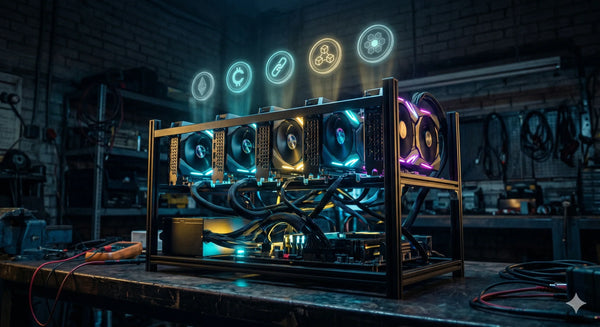
The single 8-pin power connector is a practical win for rig builders. It simplifies cabling compared to cards requiring dual 8-pin or the newer 12VHPWR connectors. If you're building a multi-GPU rig using a 2000W mining PSU and an open frame chassis, fewer power cables per card means cleaner builds and easier maintenance.
Estimated Mining Hashrates
Community benchmarks and mining profitability trackers have been compiling early data on the RX 9060 XT 16GB since its June 2025 launch. Here's what the numbers look like across the most common GPU-mineable algorithms, based on aggregated reports from Hashrate.no, Kryptex, and community submissions. These figures use moderate overclock settings — not stock, not extreme.
| Algorithm | Coin Example | Estimated Hashrate | Est. Power Draw |
|---|---|---|---|
| ETCHash | Ethereum Classic (ETC) | ~45–50 MH/s | ~110–130W |
| KawPow | Ravencoin (RVN) | ~25–30 MH/s | ~130–150W |
| Autolykos2 | Ergo (ERG) | ~140–160 MH/s | ~100–120W |
| Blake3 | Alephium (ALPH) | ~1.2–1.5 GH/s | ~120–140W |
| FishHash | IRON Fish | ~15–18 MH/s | ~120–140W |
Important caveat: these are early estimates based on limited community data. Actual performance varies by card model, driver version, cooling solution, and overclock settings. RDNA 4 is still a new architecture for mining software developers, and driver optimisations could shift these numbers in either direction over the coming months. Treat these as ballpark figures, not guarantees.
For context, the RX 9060 XT's ETCHash performance puts it roughly in line with the RX 6700 XT (which typically hits 46–48 MH/s on ETCHash) but at significantly lower power draw — making it more efficient per watt. It comfortably outpaces the RX 6600 XT and older cards like the RX 5700 XT.
How It Compares to Other Mining GPUs
If you're weighing up whether to add an RX 9060 XT to your rig or stick with what's already available, here's a quick comparison using ETCHash as the common benchmark. Our full guide on building a GPU mining rig covers the broader hardware picture.
| GPU | ETCHash (est.) | Power Draw | Efficiency (MH/W) |
|---|---|---|---|
| RX 9060 XT 16GB | ~48 MH/s | ~120W | ~0.40 |
| RX 6700 XT | ~47 MH/s | ~140W | ~0.34 |
| RX 6800 XT | ~62 MH/s | ~150W | ~0.41 |
| RX 6600 XT | ~32 MH/s | ~75W | ~0.43 |
| RX 5700 XT | ~54 MH/s | ~135W | ~0.40 |
| RTX 3080 10GB | ~95 MH/s | ~230W | ~0.41 |
| RTX 2080 Ti 22GB | ~55 MH/s | ~165W | ~0.33 |
The takeaway: the 9060 XT isn't the highest raw hashrate card, but its efficiency is competitive. For Australian miners where every cent per kWh matters, efficiency is often more important than peak hashrate.
Overclocking and Undervolting Potential
RDNA 4 has shown excellent tuning headroom across the board, and the 9060 XT is no exception. Early adopters have reported pushing the core clock to 3.4–3.5 GHz while undervolting by 40–50mV, keeping total board power under 200W with meaningful performance gains.
There's one notable limitation: the memory appears difficult to overclock beyond its stock 2,538 MHz speed. Multiple users have reported crashes when pushing memory clocks higher, which suggests AMD has left very little headroom on the GDDR6 memory controller. This is a relevant constraint for mining, where memory bandwidth often matters more than core clock speed on memory-intensive algorithms like ETCHash.
For mining-specific tuning, the better approach is likely to focus on undervolting the core to reduce power draw while maintaining stock or near-stock memory speeds. This maximises efficiency — the metric that actually matters for profitability. If you're new to GPU tuning, our guides on building a mining rig and monitoring via hashrate and temperature stats cover the fundamentals.
Tools like HiveOS and MSI Afterburner both support RDNA 4 cards, though driver maturity is still evolving. Expect mining software and overclocking profiles to improve as the card matures in the market.
The Australian Profitability Question
Here's where we have to be direct. At Australian electricity rates, GPU mining profitability is extremely challenging in mid-2026. Based on Hashrate.no estimates, the RX 9060 XT 16GB generates roughly USD $0.35–$0.87/day in gross revenue before electricity costs (depending on the algorithm and coin prices on any given day). At USD $0.10/kWh — a rate most Australians can only dream of — daily profit sits around $0.14–$0.66.
Now let's look at what Australians actually pay, using figures from our state-by-state electricity comparison:
| State | Rate (AUD/kWh) | Daily Electricity Cost (120W card) |
|---|---|---|
| QLD | $0.28 | $0.81 |
| VIC | $0.30 | $0.86 |
| WA | $0.31 | $0.89 |
| NSW | $0.33 | $0.95 |
| SA | $0.38 | $1.09 |
At current difficulty levels and coin prices, most Australian GPU miners are operating at a loss on a daily cash-flow basis — and that applies to every consumer GPU on the market, not just the 9060 XT. The RX 9060 XT's advantage is that its losses are smaller per card due to better efficiency, which matters if you're mining speculatively (accumulating coins you believe will appreciate).
If you're running solar panels, the equation shifts substantially. At 120W draw, a single 9060 XT can run entirely on excess solar generation during daylight hours, effectively reducing your marginal electricity cost to near zero. Our guide on finding cheaper electricity covers other strategies like time-of-use tariffs and off-peak scheduling.
8GB vs 16GB: Which Version for Mining?
The 16GB model is the only serious option for mining. Here's why.
GPU-mineable algorithms that use a growing DAG (directed acyclic graph) — like ETCHash for Ethereum Classic — require the DAG to fit in VRAM. The ETC DAG is currently over 5GB and grows over time. An 8GB card will eventually hit the wall, just as 4GB cards were pushed out of Ethereum mining years ago. The 16GB model gives you years of headroom.
Beyond DAG size, the 16GB model's larger VRAM buffer provides more flexibility for mining different algorithms and coins as market conditions change. If a new GPU-mineable coin launches with memory-intensive requirements, you won't be locked out.
The price difference between the 8GB ($299 USD) and 16GB ($349 USD) models is small enough that the 16GB variant is the obvious choice for anyone with mining in mind — even as a secondary use case alongside gaming.
The 128-bit Memory Bus: A Mining Limitation?
One spec that raises eyebrows in mining circles is the 128-bit memory bus. Previous-generation mining favourites like the RX 5700 XT (256-bit) and RX 6800 XT (256-bit) had wider buses that delivered more raw memory bandwidth — a key factor for memory-bound algorithms.
The 9060 XT compensates with 20 Gbps GDDR6 speeds and AMD's Infinity Cache, which reduces the number of memory accesses that hit the DRAM. For gaming, this trade-off works well. For mining, the impact depends on the algorithm. Memory-bound workloads like ETCHash are more sensitive to bus width than compute-bound algorithms like KawPow or Blake3.
In practice, the ~48 MH/s ETCHash figure suggests the 128-bit bus isn't a fatal flaw — the card still delivers respectable per-watt performance. But it does explain why the 9060 XT's raw ETCHash hashrate doesn't exceed the older 5700 XT despite having a dramatically newer architecture. The narrower bus is the bottleneck.
GPU Mining vs ASIC Mining: Where Does the 9060 XT Fit?
For Australian miners weighing up a GPU purchase versus a dedicated ASIC, the calculus is different than it was a few years ago. As we've covered in our ASIC vs GPU comparison, ASICs dominate on efficiency for their specific algorithms, while GPUs offer flexibility to switch between coins.
Consider the alternatives in the MinerHub range:
- For Ethereum Classic specifically, the iPollo V2X delivers 1,200 MH/s at just 165W — roughly 25 times the hashrate of an RX 9060 XT at barely more power. If ETC is your target, the ASIC is objectively better.
- For Alephium (Blake3), the Goldshell AL BOX II Pro at 950 GH/s absolutely dwarfs what any GPU can achieve on the same algorithm.
- For Scrypt coins like Dogecoin and Litecoin, the Goldshell Mini Doge III or Elphapex DG Home are far more cost-effective than GPU mining on Scrypt.
The GPU's advantage is versatility. You can mine ETC today, switch to Ravencoin tomorrow, try Ergo next week, and game on it when nothing's profitable. You can't do that with an ASIC. For miners who want a dual-purpose card that earns crypto when idle and plays games when you're at the desk, the 9060 XT makes sense in a way no ASIC can.
Should You Buy One for Mining?
Let's be honest about what the RX 9060 XT is and isn't.
It is an efficient, well-priced GPU with solid mining performance for its power bracket. The 16GB VRAM future-proofs it, the single 8-pin connector simplifies rig builds, and RDNA 4's efficiency means your losses at Australian electricity rates are smaller than with older, hungrier cards.
It is not a card that will generate positive daily cash flow at current Australian electricity rates and network difficulty levels. No consumer GPU is, as of mid-2026. That's the honest reality of GPU mining in a high-electricity market.
Where the 9060 XT shines is as a dual-purpose investment. Buy it for gaming, use it for mining during idle hours (especially if you have solar), accumulate coins you believe in, and claim the hardware depreciation on your tax return if you're operating as a business. That's the strategy that makes sense for most Australian GPU miners in 2026.
If mining profitability is your primary goal and you're less concerned about flexibility, our altcoin ASIC range or Bitcoin ASICs will deliver better returns per dollar and per watt on their respective algorithms. And if you're just getting started, our beginner ASIC guide covers entry-level options under $500.
What to Watch Next
A few developments could shift the 9060 XT's mining story in the coming months:
- Driver maturity: AMD's mining-relevant driver optimisations for RDNA 4 are still evolving. Expect incremental hashrate improvements as drivers mature and mining software developers optimise for the new architecture.
- New algorithms: If a significant new GPU-mineable coin launches, the 9060 XT's 16GB VRAM and modern compute capabilities position it well to mine from day one.
- Coin price movements: A meaningful rally in ETC, RVN, ERG, or other GPU-mineable coins could tip the profitability equation back into positive territory, even at Australian rates.
- Non-XT model: AMD hasn't officially confirmed a standard RX 9060 (non-XT). If it launches at a lower price with slightly reduced specs, it could become an even more interesting mining card depending on the efficiency trade-off.
We'll update this guide as more hashrate data and mining benchmarks become available. In the meantime, browse the Gigabyte RX 9060 XT Gaming OC ICE 16G in the MinerHub store, or explore our full range of mining GPUs and GPU mining hardware. Have questions? Get in touch — we're happy to help.