Alephium has carved out a quiet but interesting corner of the proof-of-work world. It runs on the Blake3 algorithm, uses a sharded UTXO design the project calls "Proof of Less Work," and — unlike Bitcoin or even Kaspa at this point — is still genuinely accessible to home miners with a decent GPU. For Australian miners who already own gaming hardware or run a small rig, ALPH is one of the few altcoins where you don't need an industrial setup to participate.
That said, the network is changing fast. Bitmain's AL3 series and other dedicated Blake3 ASICs are pushing GPU profitability down, and the same lifecycle we've seen with Ethereum Classic and Kaspa is playing out here too. This guide walks through what Alephium actually is, what hardware works in 2026, how to set up a wallet and pool, and whether mining ALPH from Australia makes sense given local electricity prices.
What is Alephium and why mine it?
Alephium is a layer-1 blockchain that went live in late 2021 with a fair launch — no premine, no VC allocation. It combines Bitcoin-style UTXO accounting with smart contract capability, and splits its network into 16 shard groups that produce blocks concurrently. The native token is ALPH, and it's mined using Blake3, a hash function introduced in 2020 that runs significantly faster than SHA-256 on the same silicon.
The pitch for miners is straightforward: Blake3 is energy-efficient, the network is far less saturated than Bitcoin, and block rewards still flow to relatively modest hashrate contributions. For a deeper comparison of where altcoins sit relative to Bitcoin in 2026, see our breakdown on altcoin mining vs Bitcoin mining.
GPU mining vs ASIC mining for Alephium
Alephium is one of the last meaningful coins where both GPUs and ASICs are still competitive — though the window for GPU-only profitability is narrowing.
GPU mining
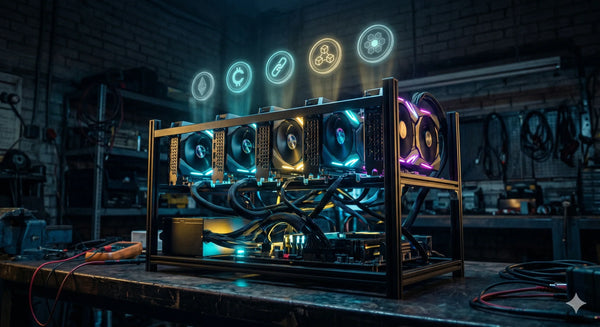
NVIDIA cards from the RTX 3060 Ti up handle Blake3 well, with RTX 4070-class cards generally offering the best efficiency for the price. AMD cards work but lag behind on power draw per hash. If you already own a gaming PC or a multi-GPU rig, ALPH is one of the most beginner-friendly coins you can point it at.
Cards in the MinerHub catalogue that suit ALPH mining include the ASUS TUF RTX 3080 10GB, the Sapphire NITRO+ RX 6700 XT, and the Gigabyte RX 9060 XT. The full lineup is at mining GPUs, and if you're building a rig from scratch our GPU mining rig parts guide covers everything from the frame to the PSU.
ASIC mining
Dedicated Blake3 ASICs — most notably the Bitmain Antminer AL3 series — push roughly 8 TH/s at around 3200W. That's a different class of operation: higher hashrate, far better efficiency per hash, but also far more heat, noise, and capital outlay. ALPH ASIC pricing is still volatile and most units are sold direct from manufacturers or via specialist resellers offshore. MinerHub doesn't currently stock Blake3 ASICs — we focus on Bitcoin, Scrypt, KHeavyHash and ETC-class machines you'll find in our ASIC miners collection.
For a broader view of the ASIC-vs-GPU economics, our ASIC mining vs GPU mining in 2026 piece breaks down the trade-offs in detail.
What you'll need to start mining ALPH
- Hardware — a GPU (or rig of GPUs) or a Blake3 ASIC.
- An Alephium wallet — to receive payouts.
- A mining pool account — unless you're solo mining, which isn't realistic at typical home hashrates.
- Mining software — for GPUs, options include lolMiner, Bzminer and SRBMiner-Multi. ASICs come with firmware preconfigured.
- Stable power and cooling — Australia's 240V/10A circuits are generally fine for a single 6-GPU rig or one mid-tier ASIC, but anything beyond that needs careful planning.
Setting up an Alephium wallet
The official options are the Alephium desktop wallet and the mobile app, both available from alephium.org. Alephium also has a browser extension wallet for interacting with dApps. Whichever you choose, write the seed phrase down on paper, store it offline, and never enter it into anything except the official wallet software.
If you'd rather have payouts go straight to an exchange that supports ALPH deposits, that works too — but check whether the exchange operates under AUSTRAC registration before sending anything sizeable to it.
Choosing a mining pool
Solo mining ALPH isn't realistic for most home miners, so a pool is the practical starting point. The major options in 2026 include:
- HeroMiners — PPS+ and PROPX payout, low fees, global server fleet.
- f2pool — 1% PPLNS, large operator with Asia-region servers that give Australia decent latency.
- Woolypooly — runs a dedicated Australian server, which keeps ping under 100 ms for most of the east coast and Perth.
- Humpool, K1Pool, Kryptex — smaller but reputable alternatives listed in Alephium's own documentation.
For Australian miners, latency matters more than headline fee numbers — a pool with Sydney, Singapore or Tokyo servers will almost always outperform a cheaper US/EU pool on stale share rates. Our guide to joining a mining pool from Australia covers latency testing and configuration in more depth, and mining pool vs solo mining walks through the maths on why pools win for small operators.
Configuring your miner
For a GPU rig running lolMiner, the basic configuration looks like this:
lolMiner.exe --algo ALEPHIUM --pool alph-asia.f2pool.com:5600 --user YourWalletAddress.WorkerNameSubstitute the pool URL with whichever pool you've picked, and replace the wallet address with your own ALPH address. For ASICs, you'll enter the same stratum URL, wallet address and worker name through the miner's web dashboard. Our explainer on reading miner stats is worth bookmarking for the first few days of tuning.
Power, profit and the Australian context
This is where Australian miners need to be brutally honest. Industry profitability models for ALPH GPU mining typically assume electricity at USD $0.08/kWh — roughly 12 AUD cents. Most Australians pay between 28c and 45c per kWh on standard residential plans. That gap eats most of the projected daily profit and is why some setups that look attractive on overseas calculators end up losing money here.
Three levers actually move the needle:
- Time-of-use plans — off-peak rates in some states drop below 20c/kWh. State-by-state numbers are in our WA vs QLD vs NSW electricity rates comparison.
- Solar self-consumption — daytime mining on rooftop solar shifts the maths significantly. We cover this in solar power and Bitcoin mining in Australia.
- Undervolting and power tuning — dropping a GPU's power limit by 20–30% typically costs only single-digit hashrate but cuts the electricity bill meaningfully.
For the broader picture on what local power costs do to mining margins, see electricity prices in Australia and the real cost of crypto mining.
Tax and legal considerations
The ATO treats mined cryptocurrency as ordinary income at its market value when received, with CGT applying to any subsequent gains when you sell or swap. Hobby miners and miners running as a business are taxed differently, and the threshold between the two isn't always obvious. Our ATO crypto mining tax guide and the piece on whether you need an ABN to mine walk through both scenarios. If you're buying hardware as a business asset, hardware depreciation under ATO rules is worth a read too.
Is Alephium mining worth it in Australia?
Realistically: it's a "yes, if" answer.
Yes, if you already own capable NVIDIA GPUs, have access to off-peak power or solar, and treat ALPH as a long-term token bet rather than a daily cashflow play. The network is still GPU-friendly, the project has working smart contract infrastructure, and the token has held reasonable exchange liquidity. The small-network upside that made early Kaspa miners well-paid could repeat here.
Probably not, if you're buying hardware specifically to mine ALPH at retail Australian power prices and expecting positive ROI in months rather than years. For that profile, Blake3 ASICs offer better economics but a much higher entry cost, or you'd be better served by a lower-power Scrypt or SHA-256 machine from our altcoin miners or Bitcoin miners ranges.
If you're putting a rig together to mine ALPH (or to switch between ALPH, Kaspa, ETC and Ergo based on profitability), the supporting hardware is straightforward. A six-GPU open frame chassis, the ASRock H510 PRO BTC+ motherboard, and a 2000W modular mining PSU are the standard combination, all available in our rig accessories range.
Final word
Alephium occupies a useful middle ground in 2026: technically interesting, GPU-mineable for now, ASIC-served for serious operators, and small enough that an Australian home miner can still meaningfully contribute hashrate. The hard limit, as always, is power cost. Get that right — through tariffs, solar, or undervolting — and Blake3 mining is one of the more sensible altcoin plays available locally. Get it wrong, and no amount of clever software tuning will fix the spreadsheet.
Have a look at our mining GPU range and rig accessories if you're ready to start, or browse the mining blog for more Australia-specific guides.