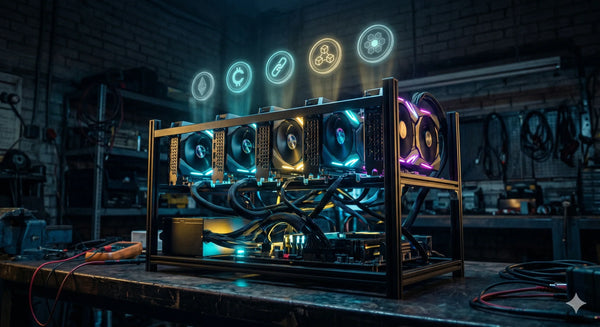
ASIC miners are essentially space heaters that pay you back in cryptocurrency — at least in theory. Every watt of electricity that passes through your miner becomes heat, and in most home setups that heat is just exhausted out a window or into a roof cavity and forgotten. But for Australian miners, especially those running machines year-round in climates ranging from Perth's dry summers to Melbourne's cold winters, capturing and redirecting that heat can meaningfully reduce the cost of running hot water, heating a room, or even warming a swimming pool. This guide looks at the practical options, the limitations, and what kind of setup actually makes the numbers work in an Australian context.
Why Heat Reuse Makes Sense for Australian Home Miners
The economics of home crypto mining in Australia are tightly constrained by electricity cost. At 30–35 cents per kWh — which is typical across most of the east coast — even a reasonably efficient ASIC is fighting hard to stay in profit. Any strategy that extracts secondary value from the electricity you are already paying for improves the overall equation.
Heat reuse doesn't reduce your electricity bill directly. What it does is offset spending you would otherwise make on gas, resistance heating, or hot water. If your 3,500W miner is heating your garage, you are not running a 2kW electric panel heater in there as well. That offset is real money, and in the right setup it can amount to several hundred dollars per year.
The other factor specific to Australia is the extremes of the climate. Running an Antminer S21 or an Antminer S21 Pro through a Perth summer requires active cooling effort — see our guide on thermal management for ASIC miners in Australian conditions. But through a Melbourne, Canberra, or even a cool Perth winter night, that same heat is genuinely useful.
Understanding the Heat Your Miner Produces
Before designing a heat reuse setup, you need to understand the form that heat takes and how it leaves your miner.
Most ASIC miners use forced-air cooling. High-speed fans pull ambient air across heatsink-covered hashboards and exhaust it out the back at elevated temperature. Depending on the machine and the ambient temperature, exhaust air from a large miner typically exits in the range of 50–70°C. The volume is also significant — a machine like the S21 moves several cubic metres of air per minute.
Smaller miners, particularly the desktop and plug-in class, run at lower power and lower temperatures. The Canaan Avalon Q, Avalon Nano 3S, and NerdQX produce much less heat — useful for warming a small room but not practical for hot water or pool heating applications. The machines that make heat reuse economically interesting are the mid-to-large class drawing 1,500W or more continuously.
Understanding which machines you have, and what power they actually draw, is the starting point. For more on reading your machine's actual operating figures, see our guide on how to read your miner's stats.
Option 1: Space Heating
The simplest heat reuse application is also the most immediate: use the exhaust air from your miner to warm a room or enclosed space. No additional equipment is required. You just need to manage airflow so the heat goes where you want it rather than being vented outside.
Garage and shed mining
If you are running your miner in a shed or garage — a common setup that has its own zoning and permits considerations — the exhaust heat can keep the space comfortable through winter without any additional heating. A well-insulated double-garage with two or three mid-size ASICs running may not need supplementary heating at all below around 15°C ambient.
The practical setup is simple: during winter, close or restrict the fresh-air intake so the miner's exhaust recirculates into the space. During summer, open the space fully and vent exhaust outside. This requires some manual management or basic automation with a temperature-controlled damper.
Adjoining room heating
A more refined version routes the miner's hot exhaust through ducting into an adjoining room or utility space. This keeps the miner noise contained in one room while delivering the heat benefit somewhere more useful. The ducting itself is standard HVAC flex duct and is inexpensive. The engineering challenge is managing backpressure — ASIC fans are not designed to push air through long duct runs, and resistance will cause them to work harder, raise temperatures, and potentially trigger throttling or shutdown.
Short duct runs of under two metres with minimal bends are generally fine for large miners. Beyond that, a supplementary inline fan is recommended to assist the flow.
What it is realistically worth
A 3,500W miner running at full load is producing the equivalent of a large reverse-cycle air conditioner's heating output, continuously. At current gas prices (roughly $0.03–0.05/MJ in most states) and electricity costs for a typical panel heater, offsetting that heating for six months of the year could save $400–$700 per year depending on your location. That is not a life-changing number, but across a longer operating life it adds up.
Option 2: Domestic Hot Water Pre-Heating
Heating water is one of the highest energy costs in an Australian household, accounting for 20–30% of a typical home energy bill. Using ASIC exhaust heat to pre-heat your hot water system is a more complex project but potentially more valuable, because hot water demand is year-round rather than seasonal.
Air-to-water heat exchanger approach
The most practical approach for most home miners uses an air-to-water heat exchanger — essentially a radiator coil — placed in the exhaust airstream of the miner. Water (or a glycol solution in cold climates) is circulated through the coil, absorbs heat from the exhaust air, and is then passed into a storage tank or a pre-heat loop before your existing hot water system.
This can meaningfully raise the inlet temperature of water entering your hot water unit, reducing the energy it needs to apply to reach your set-point temperature. If your cold water supply enters at 15°C and the heat exchanger raises it to 35°C before it enters the hot water unit, you have effectively halved the work the heater needs to do.
What the numbers look like
A 3,500W miner with roughly 3,000W of heat recoverable (some is lost to the environment) could theoretically deliver around 72kWh of heat per day. A typical Australian household uses 10–20kWh per day for hot water. In practice, heat exchanger efficiency means you are capturing a fraction of that, but even at 20–30% capture efficiency you are adding 2–5kWh of useful heat daily — worth around $0.60–$1.75 per day at current electricity prices, or $220–$640 per year.
This is in the territory where a well-engineered system starts to justify the cost of installation if you are running a larger machine or multiple machines long-term.
Considerations
Hot water systems in Australia are subject to plumbing standards and in some states any modifications to a hot water system require a licensed plumber. Pre-heating via a separate heat exchanger and storage tank that feeds the inlet of your existing system avoids touching the certified system itself and is generally DIY-legal, but check with your local council and insurer.
You also need to ensure the heat exchanger does not restrict airflow to the miner. If the miner overheats because you have added backpressure or restricted its exhaust, you are degrading the hardware and potentially causing early failure — which defeats the purpose entirely. Monitor temperatures carefully, especially when first commissioning a new setup. Our guide on remotely monitoring your ASIC miner covers the tools that can help with this.
Option 3: Swimming Pool Heating
For miners who have a backyard pool — common in Queensland and WA — using ASIC heat to extend the swimming season is one of the more creative applications. Pool heating is a significant expense, with gas or heat pump systems typically costing $500–$1,500 per year to run depending on pool size and desired temperature.
How it works
Pool heating via ASIC exhaust follows the same air-to-water heat exchanger principle as domestic hot water, but at larger scale. Pool water is circulated through a heat exchanger coil placed in the miner's exhaust, then returned to the pool slightly warmer. Because pools contain thousands of litres of water with significant thermal mass, temperature rise is slow but the system can run continuously and the energy input accumulates over days and weeks.
An alternative approach is to use a hydronic loop — a closed glycol circuit that absorbs miner exhaust heat and transfers it to the pool via a separate water-to-water heat exchanger. This isolates the pool water from the miner environment and is cleaner from a maintenance perspective.
Practical expectations
A single large miner is unlikely to be the sole heating source for a full-size pool. A 50,000L backyard pool loses heat at a rate that varies enormously with ambient temperature, wind, and whether a cover is used, but a rough figure for a Queensland autumn or Perth winter is 0.5–2°C of temperature loss per day without heating. Recovering that with a single ASIC heat exchanger is feasible for a small plunge pool or spa, but a full-size pool would benefit more from multiple machines or a hybrid system combining miner heat with a small conventional heat pump.
Where pool heating makes the most sense is in WA and QLD, where the pool season is longer and where even mild heat input extends usability. If you are running a fleet of ASIC miners in a purpose-built mining shed, the aggregate heat output becomes genuinely significant for a pool heating application.
Immersion Cooling: A Different Paradigm
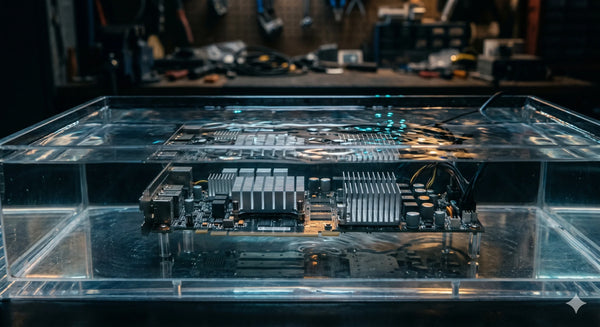
Immersion cooling — submerging mining hardware in dielectric fluid — changes the heat reuse equation entirely. Rather than exhaust air as the heat carrier, the fluid itself becomes a liquid coolant that can be pumped through a heat exchanger at far higher efficiency than an air-to-water approach.
Immersion systems used in commercial mining operations are sometimes connected directly to hydronic heating systems, swimming pools, or agricultural applications. At home scale, the barrier is cost and complexity: an immersion tank, dielectric fluid, pumps, and plumbing represent a significant upfront investment. That said, immersion cooling also enables running miners at higher clock speeds with better thermal stability, which can offset some of the infrastructure cost through improved mining returns.
For most home miners in Australia, immersion is still an enthusiast or semi-commercial proposition. Worth knowing about, but probably not your first step.
Which Machines Are Best for Heat Reuse?
Not every miner is equally suited to heat reuse applications. The key variables are total power draw, exhaust air volume, and exhaust temperature.
The large-format miners draw the most power and produce the most heat. The Antminer S21 Pro at around 3,500W, the Antminer S21, the WhatsMiner M31S+, and the WhatsMiner M30S are all in the 2,500–3,500W range and produce significant, consistent heat output. These are the machines that make engineered heat recovery worthwhile.
Mid-range machines like the Antminer S19K Pro, Avalon A1346, and Avalon A1246 at 1,500–2,500W are well suited to space heating and modest hot water pre-heating. These are a practical starting point for someone new to heat reuse who doesn't want to over-engineer the installation.
Scrypt miners like the Elphapex DG Home and the Antminer L3++ also produce meaningful heat at 1,200–1,500W and are reasonable candidates for space heating.
Small desktop miners — the Lucky Miner LV08, Lucky Miner LV06, or Gamma 602 — produce minimal heat. They are suitable as desk or shelf warmers in a home office but not for engineered heat recovery systems.
Seasonal Strategy: Switching Between Venting and Recirculating
An important practical consideration is that most Australian climates require different heat management in summer versus winter. A setup designed only for heat reuse may create problems in the warmer months if it lacks the ability to vent heat effectively.
The best setups are designed from the outset to switch modes — recirculating exhaust in winter, venting it fully in summer. This can be done with simple manually-operated dampers or with motorised dampers controlled by a thermostat. A temperature controller connected to a motorised damper can automate this based on intake air temperature, ensuring the miner is never operating in overly-hot recirculated air during summer.
For miners in Perth or northern QLD, the priority may actually be the reverse: invest first in effective summer cooling, and treat winter heat reuse as a secondary benefit. Our breakdown of electricity rates across WA, QLD, and NSW is worth reading alongside your heat reuse planning, because where you are in Australia significantly affects which season is the harder challenge.
Estimating the Financial Offset
To make a rough estimate of what heat reuse is worth for your setup, work through these steps:
- Total machine wattage: Add up the actual wall power draw of all running machines. This is your maximum heat generation rate.
- Hours per day: Miners run continuously, so multiply by 24 for daily kWh of heat generated.
- Capture efficiency: A simple duct-and-recirculate approach in an enclosed space is highly efficient — call it 80–90%. An air-to-water heat exchanger is typically 30–60% efficient at capturing useful heat from exhaust air.
- Offset value: Compare the captured heat against what you would otherwise pay. For space heating, compare against reverse-cycle heating or gas. For hot water, compare against your hot water system's running cost. For pool heating, compare against your pool heater running cost.
- Seasonal adjustment: Apply this offset only to the months where heating is actually useful for your climate.
A household in Melbourne running two mid-size ASICs through six months of winter with a basic duct recirculation setup could realistically offset $400–$800 in winter heating costs. That is not the primary reason to mine, but it is a meaningful improvement to the overall economics — especially during periods when mining margins are tighter. For a broader view on profitability, our post on electricity prices and the real cost of crypto mining in Australia is worth reading alongside this one.
Combining Heat Reuse with Solar
If you are already running solar panels, heat reuse becomes even more attractive. Free or near-free electricity during daylight hours means the heat your miner produces during the day has effectively zero energy cost attached to it. Applying that heat to hot water storage — with a well-insulated tank retaining the heat through to evening — is one of the most efficient uses of daytime solar excess a home miner can pursue.
Our dedicated post on solar power and bitcoin mining in Australia covers how to size solar for mining loads and the financial case for combining the two.
What Heat Reuse Won't Do
It's worth being clear about the limitations so you don't over-engineer a system based on unrealistic expectations.
Heat reuse will not make an unprofitable miner profitable. If your machine is generating less in mining revenue than it costs to run on electricity, the heat offset might narrow the loss but it will not eliminate it. Mining economics need to work independently of heat reuse for the setup to make long-term sense. Our post on mining versus buying crypto goes into the core economics in detail.
It also won't help you during summer in most Australian climates, which is precisely when you need your miner to exhaust heat as efficiently as possible. Heat reuse and summer thermal management are essentially opposing requirements, which is why the seasonal switching approach described above matters.
Finally, poorly designed heat capture setups can damage your equipment. Restricted airflow, recirculated hot air in summer, or exhaust condensation problems from improperly designed ductwork can all shorten hardware life. If your setup causes your miner to run hotter than it otherwise would, you are trading hardware longevity for a modest heat offset — and that is rarely a good trade. Hardware failure, warranty implications, and resale value impacts are all worth considering; our post on mining hardware resale value in Australia covers what affects second-hand prices.
Getting Started
If you are new to mining and thinking about heat reuse, start simple. Run your miner in an enclosed garage or utility room through winter with the exhaust recirculating rather than venting outside. Note what happens to the ambient temperature, observe the miner's operating temperatures, and see what the practical heat benefit is before investing in more complex ducting or heat exchanger infrastructure.
From there, if the numbers and the practical experience support it, a duct-to-room or duct-to-storage-tank system is a reasonable next project. Hot water pre-heating and pool heating are worth engineering properly if you are running two or more larger machines long-term.
Browse our full range of ASIC miners and Bitcoin miners to see which machines best suit your heat output requirements. If you're deciding between machines, our post on when to upgrade your miner and the breakdown of Bitmain vs MicroBT vs Canaan are useful reading before you commit.