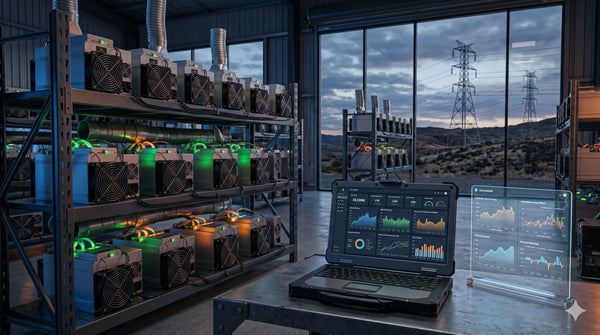
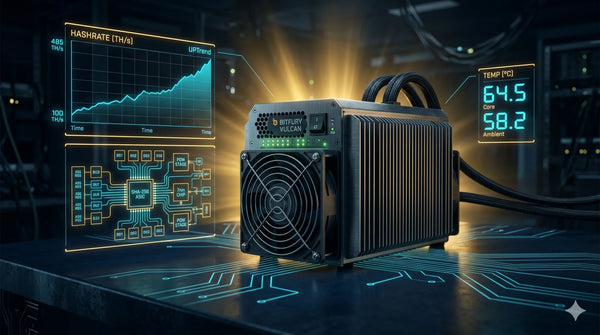
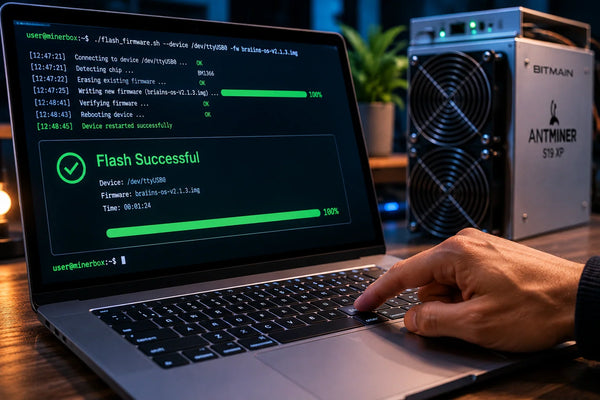
The question isn't new, but the answer keeps shifting with the market. Post-Bitcoin halving, rising network difficulty, and maturing exchange infrastructure have made both paths simultaneously more competitive and more accessible. So in 2025, should you be spinning up ASIC mining hardware, or simply dollar-cost averaging on an exchange?
The honest answer is: it depends on who you are. But we can strip away the noise and give you a clear framework to decide.
What Does "Mining" Actually Mean in 2025?
Crypto mining — specifically Proof-of-Work (PoW) mining — means running specialised hardware to validate transactions on a blockchain. In return, the network pays you in newly minted coins. For Bitcoin, that means SHA-256 ASIC miners. For altcoins like Litecoin, Dogecoin, or Kaspa, it means algorithm-specific altcoin miners.
Mining isn't passive income in the set-and-forget sense — it's a business operation. You're buying, running, and maintaining hardware that depreciates, consumes power, and requires management. The reward is that you accumulate crypto at a cost-per-coin that can be lower than the market price — but only if you're running efficiently.
What Does "Buying" Crypto Mean?
Buying crypto means acquiring coins directly through an exchange (Swyftx, CoinSpot, Kraken, Binance) using fiat currency. You pay the spot price, plus a trading fee, and you own the asset outright. Simple, liquid, and capital-light compared to mining.
The appeal is obvious: no hardware to source, no power bills to manage, no noise in the spare room. You can start with $50 or $50,000, and you're exposed to price appreciation the moment you buy. The downside? You're paying full retail for your coins.
Head-to-Head Comparison
Let's put both strategies side by side across every dimension that matters for an Australian investor in the current market:
| Factor | ⛏ Mining | 💸 Buying |
|---|---|---|
| Upfront Cost | $3,000–$20,000+ (hardware) | Any amount |
| Ongoing Cost | Electricity + maintenance | Minimal (holding fees) |
| Cost Per Coin | Often below market (if efficient) | Full spot price |
| Break-Even Period | 6–18 months typical | Immediate |
| Complexity | High (setup, maintenance) | Very low |
| Passive Income | Yes — ongoing coin output | Only via staking/DeFi |
| Hardware Risk | Depreciation, obsolescence | None |
| Regulatory (AU) | Income tax on mining rewards | CGT on disposal |
| Downside Buffer | Lower cost basis = more buffer | Full exposure at entry |
| Scalability | Add more rigs as capital allows | Capital-limited |
The Case For Mining in the Current Market
Bitcoin's April 2024 halving cut the block reward from 6.25 BTC to 3.125 BTC. Historically, halvings precede bull cycles — and rising BTC prices can dramatically improve mining margins even as rewards shrink. If you're running an efficient machine and your electricity rate is reasonable, you're effectively accumulating at a discount.
The Efficiency Angle
Modern next-gen ASIC miners have improved dramatically in efficiency over the past two years. Units operating at 17–21 J/TH represent a step change from older 30–50 J/TH machines. At Australian electricity rates of $0.25–$0.35/kWh, newer hardware can still mine profitably — older machines increasingly cannot.
Altcoin Mining Opportunity
Coins like Kaspa (KHeavyHash) and Alephium have attracted serious attention from miners looking for a Bitcoin-era growth curve at lower difficulty. Altcoin ASIC miners can offer meaningful yield windows when network difficulty is low relative to price. The risk is higher, but so is the upside — particularly for early movers.
The Case For Buying in the Current Market
For most people — particularly those without the capital, space, or technical inclination for mining — buying crypto remains the most rational path to exposure. Post-spot ETF approval in the US, institutional adoption has increased structural demand for Bitcoin, which makes spot buying a more defensible long-term strategy than it was five years ago.
Dollar-cost averaging (DCA) into Bitcoin or a diversified basket of quality assets removes timing risk and requires zero operational overhead. You're not running a business — you're making an investment. These are fundamentally different activities.
Liquidity Is Real
Bought crypto can be sold in seconds. Mining hardware has a thinner secondary market, depreciates rapidly with each generation, and in a prolonged bear market can become difficult to offload at anything near purchase price. If you value flexibility, buying wins.
What Type of Person Should Mine?
You're likely a good candidate for mining if:
- ▸You have access to below-average electricity rates (off-peak tariffs, solar, commercial premises)
- ▸You can absorb a 6–18 month break-even window without stress
- ▸You have the technical aptitude to set up, troubleshoot, and maintain hardware
- ▸You want to accumulate crypto over time at a potentially lower cost basis than buying
- ▸You have space and acceptable noise tolerance (ASICs are loud)
If that describes you, browsing our full range of ASIC miners is a solid next step. You'll also want to think about rig accessories — cooling, power supplies, and frames are part of every complete mining setup.
What Type of Person Should Buy?
Buying is the better path if:
- ▸You're investing capital you'd rather keep liquid
- ▸You're early in your crypto journey and want simplicity
- ▸Your electricity rate is above $0.30/kWh and you can't improve it
- ▸You don't want the operational complexity of running hardware
- ▸You're taking a long-term (5+ year) investment view and primarily want price exposure
Can You Do Both?
Absolutely — and many experienced participants do. A common hybrid strategy is to mine altcoins with lower difficulty, convert mined coins to Bitcoin, and hold BTC long-term. This lets you acquire BTC at a cost basis below spot (if your mining economics are right) while maintaining the quality and liquidity of a blue-chip position.
Others use mining as their accumulation strategy during bear markets — when hardware is cheaper and competition is lower — while buying spot during bull runs when margins compress. The two strategies aren't mutually exclusive.
⚡ The Bottom Line
If you have favourable electricity rates, capital to deploy, and the operational appetite for it, mining offers a genuine path to acquiring crypto below market price — particularly for Bitcoin, Kaspa, and select altcoins in the current post-halving environment. If you're after simplicity, liquidity, and lower friction, buying remains the most accessible and flexible path. For many Australians, the ideal is a combination of both: mine what you can run efficiently, buy the rest on a DCA schedule, and hold for the long term.
Browse Australia's best selection of ASIC and altcoin mining hardware — backed by a Perth-based team that mines too.