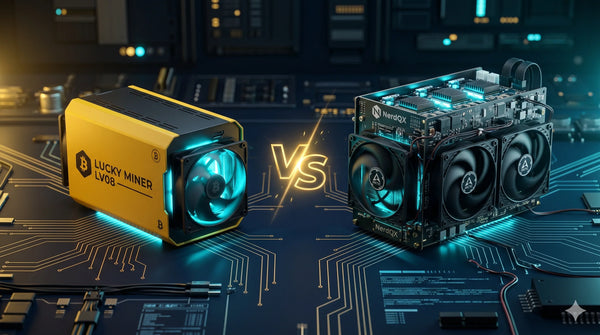
Most Bitcoin miners are closed boxes. You plug them in, point them at a pool, and trust that the firmware running on proprietary chips is doing what the manufacturer says. The NerdQX and NerdOCTAXE take a fundamentally different approach: every schematic, PCB design file, and line of firmware code is publicly available on GitHub. Anyone can audit, fork, or build from scratch.
That transparency is what makes the open-source mining movement interesting — and it's why these machines have attracted a dedicated community of builders and home miners. But they're also genuinely useful hardware for Australian home miners navigating high electricity rates, and they've produced real Bitcoin block finds.
This guide covers how the NerdQX and NerdOCTAXE work, how they differ from the Gamma 602, and what to consider before buying one.
What Is Open-Source Bitcoin Mining?
Open-source Bitcoin mining refers to ASIC mining hardware where the hardware design files, PCB schematics, bill of materials, and firmware source code are all publicly published under open licences. This is distinct from commercial ASIC miners — including machines from Bitmain, Canaan, and MicroBT — where the hardware design and firmware are proprietary.
The open-source mining ecosystem grew out of the Bitaxe project, which was the first device to successfully run a Bitmain ASIC chip (the BM1397) on fully open-source hardware. The project was developed within a community called Open Source Miners United (OSMU), and its success spawned a family of derivative designs — including the Gamma 602 (single BM1370 chip), the NerdQX (four BM1370 chips), and the NerdOCTAXE (eight BM1370 chips).
All of these devices run SHA-256, the same algorithm that powers every Bitcoin miner in existence. For a primer on what SHA-256 actually is and how the proof-of-work process works, see: What Is SHA-256 and How Does It Work?
The BM1370 Chip: Why It Matters
The BM1370 is Bitmain's most recent-generation ASIC chip, introduced with the Antminer S21 series. It operates at approximately 15–17 J/TH — among the most efficient SHA-256 chips available in 2026. The same chip that powers the Antminer S21 Pro's 234 TH/s output is what the NerdQX and NerdOCTAXE are built around.
This matters because it means open-source miners aren't running obsolete silicon. They're using current-generation chips — just in much smaller quantities, on community-designed boards, without the proprietary firmware layer that commercial ASICs run.
The trade-off is that fitting BM1370 chips onto a small open-source PCB introduces thermal and power delivery engineering challenges that the open-source community has iterated through across multiple board revisions — which is part of why paying attention to revision numbers matters when buying these devices.
The NerdQX: Four Chips, ~8 TH/s, ~180W
The NerdQX mounts four BM1370 chips on a single PCB, delivering approximately 8 TH/s of SHA-256 hashrate at around 180W. It includes an Arctic fan for active cooling, a LilyGo T-Display screen showing live stats, and Wi-Fi connectivity for pool and configuration management.
The NerdQX runs AxeOS — the same open-source firmware used across the Bitaxe and Nerd*axe family. AxeOS provides a web interface accessible from any browser on your local network, showing real-time hashrate, chip temperature, fan speed, accepted shares, and best difficulty. Configuration is handled entirely through this interface: you enter your pool address, your Bitcoin wallet address, and the miner does the rest.
NerdQX key specs
- Chips: 4× BM1370
- Hashrate: ~8 TH/s (up to ~8.1 TH/s overclocked)
- Power draw: ~180W
- Efficiency: ~22.5 J/TH
- Connectivity: Wi-Fi 2.4GHz
- Display: LilyGo T-Display S3
- Firmware: AxeOS (open-source, ESP-Miner based)
- Noise: Low — desktop/home friendly
At 180W continuous, monthly electricity cost at $0.30/kWh sits around $13–$15 per month — considerably higher than the Gamma 602 at ~15W but still a fraction of what any commercial ASIC draws.
The NerdOCTAXE: Eight Chips, ~12 TH/s, ~160W
The NerdOCTAXE doubles the chip count to eight BM1370s, delivering approximately 12 TH/s. In a notable engineering achievement, the NerdOCTAXE's Rev 3.1 board — which features a redesigned 6-phase VRM and TPS53667 power controller — achieves this at approximately 160W, making it more power-efficient per terahash than some earlier revisions despite the higher chip count.
Like the NerdQX, the NerdOCTAXE runs AxeOS firmware on a LilyGo T-Display S3 screen and connects over Wi-Fi. Hardware design files are publicly available on GitHub. The Rev 3.1 board redesign was contributed by the open-source community specifically to address the power delivery issues that affected earlier revisions.
NerdOCTAXE key specs
- Chips: 8× BM1370
- Hashrate: ~12 TH/s
- Power draw: ~160W (Rev 3.1)
- Efficiency: ~16.7 J/TH (Rev 3.1)
- Connectivity: Wi-Fi 2.4GHz
- Display: LilyGo T-Display S3
- Firmware: AxeOS fork (ESP-Miner based)
- Noise: Low — desktop/home friendly
At ~160W, the NerdOCTAXE costs approximately $11–$12 per month to run at Australian residential rates — slightly less than the NerdQX despite nearly 50% more hashrate, thanks to its improved power delivery efficiency on the Rev 3.1 board.
How They Compare to the Gamma 602
The Gamma 602 is the single-chip member of the same open-source family — one BM1370 chip, approximately 1.2–1.8 TH/s, ~15W. It's the entry point to open-source Bitcoin mining: lowest cost, lowest power, smallest form factor, simplest setup.
The NerdQX and NerdOCTAXE are best understood as scaled-up versions of the same philosophy. More chips, more hashrate, more power draw — but the same open firmware, the same community, the same solo mining use case, and the same fundamental transparency about what the hardware is doing.
| Device | Chips | Hashrate | Power | Monthly cost (@ $0.30/kWh) |
|---|---|---|---|---|
| Gamma 602 | 1× BM1370 | 1.2–1.8 TH/s | ~15W | ~$1.10–$1.35 |
| NerdQX | 4× BM1370 | ~8 TH/s | ~180W | ~$13–$15 |
| NerdOCTAXE | 8× BM1370 | ~12 TH/s | ~160W | ~$11–$12 |
For a detailed look at the Gamma 602 specifically, see our review: Is the Bitaxe Gamma 602 Worth It? An Honest Review for Australian Miners
How AxeOS Firmware Works
All three devices run AxeOS, which is built on ESP-Miner — an open-source mining firmware project developed for ESP32 microcontrollers. The NerdOCTAXE runs a dedicated fork adapted for its 8-chip configuration and the LilyGo T-Display S3 display.
After connecting over Wi-Fi, AxeOS is accessible via your browser at the miner's local IP address. The interface shows:
- Real-time hashrate — current TH/s output
- Chip temperature — critical for monitoring thermal performance
- Fan speed — adjustable in firmware
- Accepted shares — confirmation the miner is communicating with the pool correctly
- Best difficulty — the most interesting metric for solo miners; a best diff approaching current network difficulty means a block find is statistically close
Pool configuration involves entering a pool URL and your Bitcoin wallet address. For solo mining, popular pools include CKPool's solo endpoint (solo.ckpool.org) and Public Pool. For pool mining, any standard Stratum-compatible pool works.
Because the firmware is open-source, the community continuously improves performance, stability, and feature support across revisions. Updates are pushed to GitHub and can be flashed via the web interface. For a broader look at what mining firmware is and how upgrades work, see: What Is Mining Firmware and Should You Flash Yours? 2026 Guide
Have Open-Source Miners Actually Found Bitcoin Blocks?
Yes — and this is one of the most compelling aspects of the community's track record.
As of April 2026, the NerdQAxe++ (the closely related predecessor to the NerdQX) had three confirmed Bitcoin block finds, with combined rewards exceeding $560,000 in BTC at the time of discovery. Block #944,078 was the most recently confirmed. The open-source mining community overall — across Bitaxe and Nerd*axe family devices — had accumulated over $1 million in aggregate block rewards.
These are statistically rare events, and they don't change the underlying probability maths for any individual miner. But they demonstrate that solo mining with open-source hardware isn't purely theoretical — the finds have happened, they've been verified on-chain, and the rewards went to the individual running the hardware.
Pool Mining vs Solo Mining on Open-Source Hardware
Open-source miners can run in either pool mining or solo mining mode, and the choice is a genuine decision with meaningfully different outcomes.
Pool mining contributes your hashrate to a collective and returns small, consistent proportional payouts. At 8–12 TH/s, these will be very small — but they're predictable and confirm the miner is working correctly day to day.
Solo mining connects directly to a solo pool endpoint. Your miner submits shares independently. If a share meets the current network difficulty target, you win the full block reward — currently 3.125 BTC plus transaction fees. The probability on any given day is low, but the machine runs at a known fixed cost, and the option value of a block find is substantial.
Most open-source miner owners run in solo mode and treat the setup as a long-duration, low-cost participation play rather than a consistent income stream. For a full breakdown of the decision, read: Mining Pool vs Solo Mining: Which Is Best for Beginners?
Setup and Practical Considerations for Australian Homes
Noise
The NerdQX and NerdOCTAXE are significantly quieter than any commercial ASIC. Active cooling fans run at low speed under normal load and produce noise comparable to a small desktop PC — around 25–35 dB. Both can run in a living space or home office without disruption.
Heat
At 160–180W, heat output is modest — roughly equivalent to two to three large incandescent light globes. No dedicated cooling or ventilation infrastructure is required for a single unit in a normal home environment.
Setup complexity
Both devices are more technically involved than a plug-and-play commercial miner. Configuration requires accessing the AxeOS web interface, entering pool details, and understanding basic mining concepts. Most users find setup takes 15–30 minutes with documentation. The community is active on Discord and GitHub for troubleshooting support.
Power supply
Both the NerdQX and NerdOCTAXE use standard PSU connectors compatible with Australian 240V supplies. No special wiring or electrician work is required.
Who Should Buy an Open-Source Miner?
Open-source miners are a strong fit for a specific type of home miner — and a poor fit for others. Here's an honest breakdown:
Good fit if you:
- Want to understand how Bitcoin mining actually works at a technical level
- Value transparency and want to know exactly what your hardware is doing
- Are approaching mining as a long-term, low-cost participation play rather than a short-term income strategy
- Are comfortable with a modest amount of initial configuration via a web interface
- Want to stay connected to the open-source Bitcoin community
Less ideal if you:
- Want a polished, app-driven setup experience with full manufacturer support
- Are expecting meaningful AUD returns in the near term at Australian electricity rates
- Need enterprise-grade warranty and replacement support
If the second list describes you better, the Canaan Avalon Nano 3S offers a comparable power footprint (140W) with a commercial build quality, official warranty, and app-based setup — at the cost of the transparency and community that comes with open-source hardware.
Browse Open-Source Bitcoin Miners at MinerHub
All three open-source Bitcoin miners are available for Australian delivery from our Bitcoin Miners collection:
- Gamma 602 Bitcoin Solo Miner — 1× BM1370, 1.2–1.8 TH/s, ~15W — the entry point to open-source Bitcoin mining
- NerdQX 8 TH/s Open-Source Bitcoin Solo Miner — 4× BM1370, ~8 TH/s, ~180W
- NerdOCTAXE 12 TH/s Open-Source Bitcoin Solo Miner — 8× BM1370, ~12 TH/s, ~160W
Questions about which device suits your setup, or want to talk through the solo vs pool decision? Get in touch — we're based in Perth and happy to help.