The Lucky Miner LV06 is one of the smallest, quietest Bitcoin miners you can buy — a palm-sized SHA-256 ASIC that draws 13W of power, connects over Wi-Fi, and can sit unnoticed on a desk or shelf while it runs continuously in the background.
For Australian home miners dealing with residential electricity rates between $0.28 and $0.35/kWh, this power profile matters enormously. At 13W, the LV06 costs roughly $1.00–$1.20 per month to run. That changes the entire profitability conversation compared to commercial ASIC miners drawing 2,000W or more.
This review covers everything worth knowing before buying: what the LV06 actually is, how it performs, what solo mining with 500 GH/s realistically looks like in 2026, and who this machine is — and isn't — suited to.
Lucky Miner LV06 Specifications
| Algorithm | SHA-256 |
| Hashrate | 500 GH/s ±10% |
| Power consumption | 13W ±10% |
| ASIC chip | BM1366 (5nm, Bitmain) |
| Noise level | ≤38 dB |
| Connectivity | 2.4GHz Wi-Fi |
| Power input | DC 5V 4A (100–240V adapter included) |
| Dimensions | 130 × 66 × 40 mm |
| Weight | 208g (net) |
| Mining modes | SOLO, PPLNS, PPS, PROP |
| Supported algorithms | SHA-256 (BTC, BCH, BSV, DGB, and 42+ coins) |
| Operating temperature | 0–35°C |
The BM1366 Chip: What It Means in Context
The LV06 is powered by Bitmain's BM1366 — the same 5nm chip architecture that sits inside the Antminer S19 XP. It's not a budget chip. The BM1366 is a proven, efficient SHA-256 processor, and its presence in a 13W palm-sized device is what makes the LV06 interesting rather than just another novelty miner.
The chip delivers 500 GH/s at approximately 26 J/TH — which, as a standalone efficiency figure, isn't competitive with top commercial miners like the Antminer S21 Pro at 15 J/TH. But efficiency figures only matter in the context of total power draw. At 13W absolute, the LV06's monthly electricity cost at Australian residential rates is around $1.10 — a figure no commercial miner can approach.
Monthly Electricity Cost at Australian Rates
Here's what the LV06 costs to run continuously at common Australian electricity rates:
| Rate (per kWh) | Daily cost | Monthly cost |
|---|---|---|
| $0.28 (low residential) | ~$0.09 | ~$0.88 |
| $0.30 (typical residential) | ~$0.09 | ~$0.94 |
| $0.35 (high residential / WA peak) | ~$0.11 | ~$1.10 |
For context: that's less than a cup of coffee per month. No commercial SHA-256 miner can operate at this cost floor in an Australian home environment. This is the LV06's defining advantage, and it's the reason the machine exists as a product category.
For a broader look at how electricity rates affect mining economics across different hardware tiers, see: Electricity Prices in Australia and the Real Cost of Crypto Mining in 2026
Solo Mining with 500 GH/s: What the Odds Actually Look Like
The LV06 is designed primarily for solo mining — connecting to a solo Bitcoin pool, attempting to find a full block independently, and claiming the entire 3.125 BTC block reward if successful.
It's important to be direct about the odds. Bitcoin's network hashrate in 2026 operates in the range of 800–1,000 exahash per second (EH/s). The LV06 contributes 0.0000005 EH/s. The probability of finding a block on any given day is statistically very small — roughly equivalent to winning a lottery.
That framing is accurate, and it's how the machine should be understood. The LV06 is not a consistent income generator. It is a low-cost, indefinitely-running lottery ticket with a very large potential prize. At under $1.10/month to operate, the question isn't "will this pay for itself in hashrate revenue?" — it's "is participating in Bitcoin's proof-of-work network for $1.10/month interesting or meaningful to me?"
For many home miners, the answer is yes. Several Bitaxe-class solo miners have found real Bitcoin blocks. The probability is low, but it is real, and the cost of maintaining that probability indefinitely is negligible.
For a full breakdown of how solo and pool mining compare, read: Mining Pool vs Solo Mining: Which Is Best for Beginners?
Can the LV06 Run Pool Mining Instead?
Yes. The LV06 supports PPLNS, PPS, and PROP pool modes in addition to SOLO, and it can connect to any standard SHA-256 mining pool (Antpool, ViaBTC, F2Pool, and others).
Pool mining with 500 GH/s means contributing a very small fraction of the pool's total hashrate and receiving proportionally small but consistent payouts. At current Bitcoin prices and network difficulty, the daily pool revenue from 500 GH/s works out to a fraction of a cent — enough to accumulate small amounts of Bitcoin over months, but not a meaningful income stream.
For the LV06 specifically, the solo mining model tends to be the more compelling use case — the payout structure is the same as pool mining in expected value terms, but with the possibility of a large single win rather than micro-accumulation over time.
How the LV06 Compares to Other Low-Power Miners in Our Range
We stock several low-power Bitcoin miners suited to Australian home environments. Here's how the LV06 sits relative to the others:
| Miner | Hashrate | Power | Monthly cost (~$0.30/kWh) | Chip |
|---|---|---|---|---|
| Lucky Miner LV06 | 500 GH/s | 13W | ~$0.94 | BM1366 (5nm) |
| Gamma 602 | 1.2–1.8 TH/s | ~15W | ~$1.08 | BM1370 (5nm) |
| NerdQX 8TH | 8 TH/s | ~20W | ~$1.44 | BM1370 (5nm) |
| Canaan Avalon Nano 3S | 6 TH/s | 140W | ~$10.08 | Canaan A1366 (5nm) |
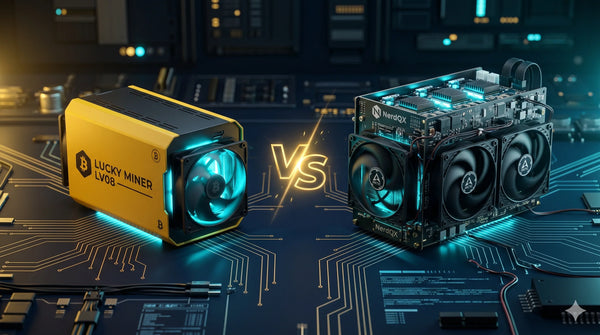
The LV06 is the lowest-cost miner to run in this group by a clear margin. The trade-off is hashrate: at 500 GH/s it contributes roughly half the hashrate of the Gamma 602 and one-sixteenth of the NerdQX. For solo mining, that means lower odds per unit time — though at under $1/month the cost of running it indefinitely is negligible.
If maximising hashrate within a minimal power budget is the priority, the NerdQX is the stronger performer. If simplicity, near-zero ongoing cost, and ease of setup are the priorities, the LV06 is hard to argue against.
Setup and Day-to-Day Use
Setup on the LV06 is genuinely plug-and-play. Connect the included power adapter, join the miner's hotspot from your phone or laptop, configure your 2.4GHz Wi-Fi network and pool details through the browser-based interface, and the machine starts hashing within minutes. No command line, no firmware flashing, no technical background required.
Day-to-day monitoring is handled through the same web interface — you can check real-time hashrate, chip temperature, pool connection status, and accumulated shares from any device on your network. The machine runs silently enough to sit on a desk without notice; at ≤38 dB it produces no meaningful fan noise in a normal room environment.
The LV06 draws power via a standard DC adapter (5V, 4A) and is compatible with 100–240V AC — Australian 240V power outlets are fully supported with the included adapter.
For a full walkthrough of setting up your first Bitcoin miner from scratch, see: How to Set Up Your First Bitcoin Miner in Australia
Who Is the Lucky Miner LV06 Built For?
The LV06 makes most sense for a specific type of Australian miner:
- Home miners priced out of commercial mining — If your electricity rate makes a 2,500W+ commercial rig unviable, the LV06 lets you participate in Bitcoin's proof-of-work at a cost that's essentially rounding error on your power bill.
- First-time miners wanting a low-stakes start — At its price point and running cost, the LV06 is the lowest-friction way to learn how Bitcoin mining works — pool configuration, hashrate monitoring, wallet setup — without a large capital commitment.
- Bitcoin enthusiasts who want to run a node and mine simultaneously — The LV06 sits neatly alongside a Bitcoin node setup as a genuinely contributing piece of the network's proof-of-work security.
- Gift or desk gadget for crypto-curious friends and family — It's small, silent, affordable, and does something real. It makes an unusual and technically credible gift.
It is not suited to miners seeking meaningful regular income, those wanting to maximise hashrate per dollar of hardware spend, or operators who want advanced open-source firmware customisation (for that, the Gamma 602 and NerdQX with AxeOS are better options).
The Verdict
The Lucky Miner LV06 is a well-executed product for what it is. The BM1366 chip is legitimate hardware, the power draw is genuinely remarkable at 13W, and the plug-and-play setup removes every technical barrier that typically stops beginners from mining at all.
The honest caveat is the same one that applies to all solo miners at this hashrate level: 500 GH/s is a very small fraction of Bitcoin's total network, and the probability of finding a block on any given day is extremely low. If you're measuring "worth it" by consistent financial return, the LV06 isn't the answer. If you're measuring it by cost to participate — to genuinely run SHA-256 hashing on Bitcoin's network for the price of a coffee per month — it's hard to beat.
For Australian home miners who've concluded that commercial mining isn't viable at their electricity rate, the LV06 is one of the most honest options on the market. It doesn't oversell itself, it runs without complaint, and it costs almost nothing to keep going.
Browse the full range of low-power and home-friendly Bitcoin miners in our Bitcoin Miners collection, or get in touch if you'd like to talk through which machine suits your setup.